
Atomic Habits for Students: 4 Laws to Study Smarter (Without Burning Out)

Does this sound familiar? You've been staring at your notes for hours, but you feel like you're not making any progress. You highlight, you re-read, but the next day, half the information has vanished. You want to be a better student, but the idea of studying "harder" exhausts you just thinking about it.
The good news is that it's not about studying more, but studying smarter. And this is where the magic of atomic habits comes in, a concept popularized by James Clear in his bestselling book. The idea is simple but powerful: small, consistent improvements have a gigantic long-term impact.
Forget about drastic transformations. Today, we're going to adapt the 4 laws of atomic habits so you can apply them directly to your studies and see results without burning out.
1st Law: Make It Obvious
The biggest enemy of a good habit is the laziness to get started. If you have to look for your notes, tidy your desk, and silence your phone every time you sit down to study, your brain will look for any excuse not to do it.
The solution is to prepare your environment for success. Make starting to study the most logical and simple action in your space.
- Prepare the night before: Before you go to sleep, get your desk ready. Open your notes to the right page, place your pencil case next to them, and fill a water bottle. When you sit down, all you'll have to do is start. Zero friction.
- Create a sacred space: Associate a specific place (your desk, a corner of the library) solely with studying. When you're there, your brain will know it's time to focus.
- Eliminate visible distractions: Is your phone your kryptonite? Don't just put it face down on silent. Take it to another room. Make the obstacle to getting distracted greater than the one to start studying.

2nd Law: Make It Attractive
Let's be honest: studying a dense law topic or a complex math formula isn't always the most appealing plan. Your brain is wired to seek rewards and dopamine. So why not give it some?
The key is to link the habit of studying with something you actually want to do. James Clear calls this "temptation bundling."
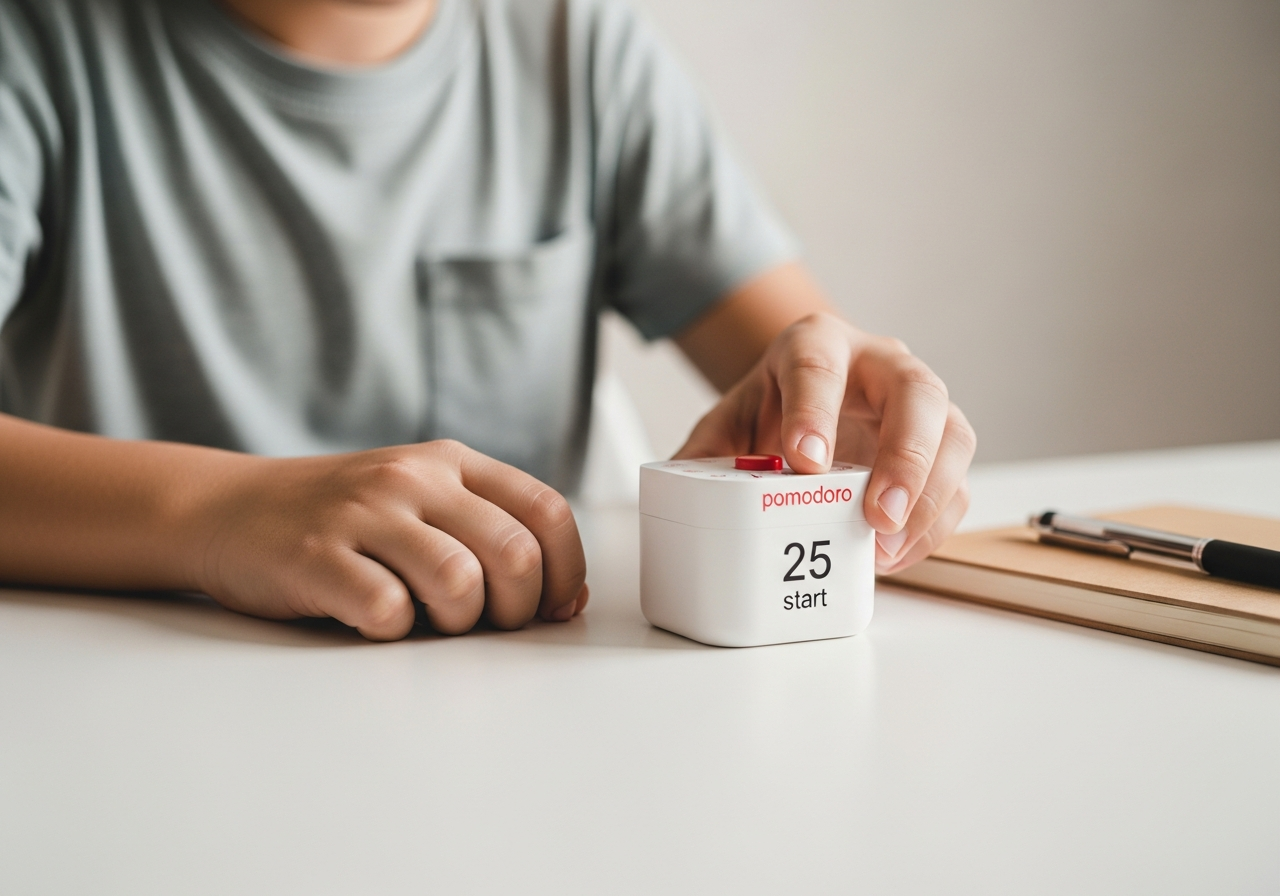
- The "after": "After I study for 25 minutes without interruption (one Pomodoro), I will allow myself to listen to my favorite podcast while I make a coffee."
- Make it a pleasant ritual: Do you like tea? Make yourself a cup of your favorite brew right before you start. Light a candle, put on some focus music... Turn "I have to study" into "It's time for my focus session."
- Gamify it: Instead of just re-reading, turn your notes into a game. Test yourself, try to guess concepts, or compete with a friend to see who gets a better score on a quiz.
Speaking of making studying more attractive... what if you could turn your boring notes into an interactive challenge?
Smartests.app does just that. You upload your notes, and the platform creates multiple-choice tests in seconds for you to test yourself. It's the perfect way to move from passive studying (reading) to active recall (remembering), which is what really makes knowledge stick.
3rd Law: Make It Easy
Motivation is like a wave: sometimes it's high, and sometimes it disappears. You can't depend on it. What you can control is the difficulty of your habits. If a habit requires a lot of effort, you'll abandon it on a bad day.
This is where the 2-Minute Rule shines: reduce any habit to a version that takes less than two minutes to complete.
- "Studying for an hour" sounds intimidating.
- "Opening my notes and reading the first paragraph" is ridiculously easy.
The goal isn't just to read one paragraph. The goal is to master the art of starting. Once you've started, it's much easier to keep going. Inertia works in your favor.
-
Instead of: "Summarizing Chapter 4."
-
Start with: "Writing the title and the first three subheadings of Chapter 4."
-
Instead of: "Doing 30 physics problems."
-
Start with: "Solving the first problem."
Once you're in motion, you'll see that continuing for 15, 30, or 60 minutes is much simpler. Reduce the friction to a minimum.
4th Law: Make It Satisfying
Your brain loves to feel good. If an action has an immediate reward, you're much more likely to repeat it. The problem with studying is that the reward (passing an exam) is far off in the future.
You need to give your brain an immediate win every time you complete your habit.
- Use a habit tracker: Get a calendar and draw a big "X" every day you meet your study goal (e.g., "study Civil Law for 30 minutes"). Watching the chain of X's grow is incredibly satisfying and will motivate you not to break it.
- Immediate reward: Right after finishing your study session, give yourself a small prize. It could be watching an episode of your favorite show, eating a piece of chocolate, or taking a short walk. The key is that it must be immediate.
- Review your progress: At the end of the week, look at everything you've accomplished. Did you finish a chapter? Did you take 5 practice tests? Acknowledge your effort. Feeling competent and seeing that you're making progress is one of the greatest satisfactions.

Quick Summary
You don't need superhuman motivation, just a smarter system. To build study habits that really work, remember the 4 laws:
- Make It Obvious: Prepare your environment so starting to study is inevitable.
- Make It Attractive: Link studying with something you enjoy so your brain craves it.
- Make It Easy: Start with an action so small you can't say no (the 2-minute rule).
- Make It Satisfying: Give yourself an immediate reward after you finish to reinforce the habit.
Ready to Put It into Practice?
Applying these principles will transform the way you study. And if you want a tool that helps you make studying more attractive, easy, and satisfying, Smartests is designed for that.
Turn reviewing into an active and rewarding challenge. Upload your notes, generate tests instantly, and check your progress in a visual and motivating way. It's time to study smarter.