
Human Anatomy I Quiz: Key Questions on the Brachial Plexus and its Branches
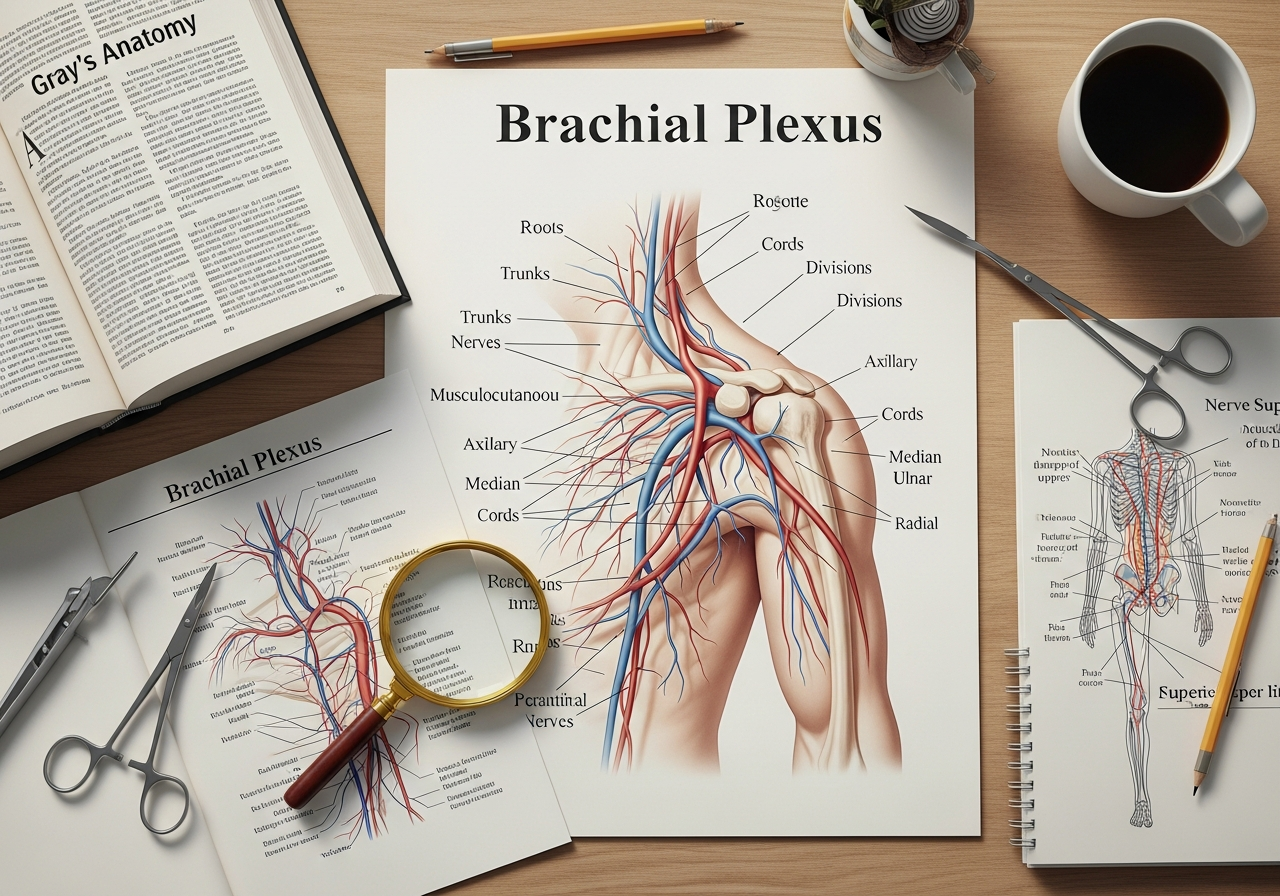
Hey, future doctor! If there's one topic in Human Anatomy I that keeps students up at night, it's the brachial plexus. Roots, trunks, divisions, cords... a maze of nerves that seems impossible to memorize. But don't worry, you're not alone. The key to mastering it isn't rereading a thousand times, but actively testing your knowledge (Active Recall). This practice quiz is designed to make you face the questions that really matter and solidify your learning. Are you ready for the challenge?
Test Yourself: Brachial Plexus and its Branches Quiz
-
Which spinal roots primarily form the brachial plexus? a) C1 - C5 b) C5 - T1 c) C4 - C8 d) T1 - T5
-
The superior trunk of the brachial plexus is formed by the union of which roots: a) C5 and C6 b) C6 and C7 c) C7 only d) C8 and T1
-
An injury to the long thoracic nerve, a supraclavicular collateral branch of the brachial plexus, produces a characteristic clinical sign known as: a) Claw hand b) Preacher's hand c) Winged scapula d) Dropped shoulder
-
Which fasciculus (or cord) of the brachial plexus gives rise exclusively to the musculocutaneous nerve and the lateral root of the median nerve? a) Medial cord b) Lateral cord c) Posterior cord d) Inferior cord
-
The axillary (circumflex) nerve, which innervates the deltoid muscle, is a terminal branch of the: a) Superior trunk b) Lateral cord c) Posterior cord d) Medial cord
-
The famous "M" of the brachial plexus, visible in the axillary fossa, is formed by the confluence of which nerves: a) Median, ulnar, and radial b) Musculocutaneous, median, and ulnar c) Axillary, median, and radial d) Subscapular, thoracodorsal, and axillary
-
Which of the following muscles is NOT innervated by the radial nerve? a) Triceps brachii b) Supinator c) Brachialis (main portion) d) Extensor carpi radialis longus
-
A fracture of the middle third of the humerus has a high risk of injuring an important nerve that runs through the radial groove. Which nerve is this? a) Median nerve b) Ulnar nerve c) Radial nerve d) Musculocutaneous nerve
-
From which structure of the brachial plexus does the suprascapular nerve, responsible for innervating the supraspinatus and infraspinatus muscles, originate? a) C5 root b) Posterior cord c) Superior trunk d) Lateral cord
-
The correct order of the structures that make up the brachial plexus from its medial origin to its lateral distribution is: a) Roots, Cords, Trunks, Divisions, Branches b) Roots, Trunks, Divisions, Cords, Branches c) Trunks, Roots, Cords, Divisions, Branches d) Branches, Cords, Divisions, Trunks, Roots
How did it go? The reasoned solutions are below. If you missed more than 3, you need to review your notes.
Answers and Explanations
1. Correct answer: b) C5 - T1
- Explanation: The brachial plexus is formed by the anterior rami of the C5, C6, C7, C8, and T1 spinal nerves. This is a fundamental question you absolutely must master.
2. Correct answer: a) C5 and C6
- Explanation: The roots unite to form the trunks. C5 and C6 unite to form the superior trunk. The C7 root continues alone as the middle trunk, and C8 and T1 unite to form the inferior trunk.
3. Correct answer: c) Winged scapula
- Explanation: The long thoracic nerve innervates the serratus anterior muscle. Paralysis of this muscle prevents the scapula from being held against the rib cage, causing its medial border to protrude, especially when pushing against a wall.
4. Correct answer: b) Lateral cord
- Explanation: The lateral cord, formed by the anterior divisions of the superior and middle trunks, gives rise to the musculocutaneous nerve and the lateral root of the median nerve.
5. Correct answer: c) Posterior cord
- Explanation: The posterior cord gives rise to five terminal branches, the most important being the axillary nerve (which wraps around the surgical neck of the humerus) and the radial nerve.
6. Correct answer: b) Musculocutaneous, median, and ulnar
- Explanation: The anatomical "M" is formed by the musculocutaneous nerve (lateral arm of the M), the median nerve (center of the M, formed by the union of the lateral and medial roots), and the ulnar nerve (medial arm of the M, which comes from the medial cord).
7. Correct answer: c) Brachialis (main portion)
- Explanation: The brachialis muscle is primarily innervated by the musculocutaneous nerve. Although the radial nerve may give a small branch to its lateral portion, its main functional innervation is not from the radial nerve. The rest of the listed muscles are innervated by the radial nerve.
8. Correct answer: c) Radial nerve
- Explanation: The radial nerve has a very close anatomical relationship with the humeral shaft as it passes through its groove (spiral groove). Fractures in this area can sever or compress the nerve, causing "wrist drop" due to paralysis of the extensor muscles.
9. Correct answer: c) Superior trunk
- Explanation: The suprascapular nerve is one of the few important collateral branches that originate at the level of the trunks (specifically from the superior one). It passes through the suprascapular notch to innervate the supraspinatus and infraspinatus muscles, which are key for shoulder rotation.
10. Correct answer: b) Roots, Trunks, Divisions, Cords, Branches
- Explanation: The classic English mnemonic is "Really Tired Drink Coffee Black" (Roots, Trunks, Divisions, Cords, Branches). Remembering this order is vital to be able to outline and understand the plexus's structure.
Where Students Often Go Wrong with the Brachial Plexus and its Branches
- Confusing the Medial Cord with the Median Nerve: A classic mistake. The medial cord is a proximal structure that gives rise to the medial root of the median nerve and the ulnar nerve. The median nerve is a terminal branch formed by the union of roots from the lateral and medial cords. They are not the same thing!
- Forgetting the Supraclavicular Collateral Branches: Most people focus on the terminal branches (median, ulnar, radial...). But professors love to ask about branches that originate "earlier," like the dorsal scapular nerve (from the C5 root) or the suprascapular nerve (from the superior trunk).
- Mixing up the clinical signs of injury: "Claw hand" (ulnar nerve injury) is often confused with "preacher's hand" (a sign that appears when trying to make a fist with a median nerve injury) and "wrist drop" (radial nerve injury). Associate each nerve with its specific clinical sign.
Is Your Exam Different?
This practice quiz covers the fundamental concepts of the brachial plexus that you would find in any standard anatomy textbook. But let's be honest, will your exam be "by the book"?
Probably not. Every professor has their favorite questions, their go-to clinical cases, and those specific details they only mentioned in their lecture. What if your exam focuses on anatomical variations we haven't covered here? This is where a generic quiz falls short.
The only way to prepare for YOUR real exam is by studying with YOUR material. Upload your notes, slides, or the PDF for the "Brachial Plexus and its Branches" topic to Smartests and let our AI generate a 100% personalized quiz for you. Practice with the questions that really matter: the ones that will come from your own notes.
Generate my personalized quiz now
Quick Summary
Today you've reviewed and tested three key concepts about the Brachial Plexus:
- The sequential structure: You've solidified the order Roots → Trunks → Divisions → Cords → Branches.
- The relationship between structure and function: You've connected specific nerves (e.g., axillary) with the muscles they innervate (e.g., deltoid) and their function (e.g., abduction).
- Clinical anatomy: You've recalled how an injury to a specific nerve structure (e.g., long thoracic nerve) translates into a visible clinical sign (e.g., winged scapula).