
HUMAN ANATOMY I (Locomotor System) Quiz: Key Questions on Carpal and Tarsal Bones (Osteology)
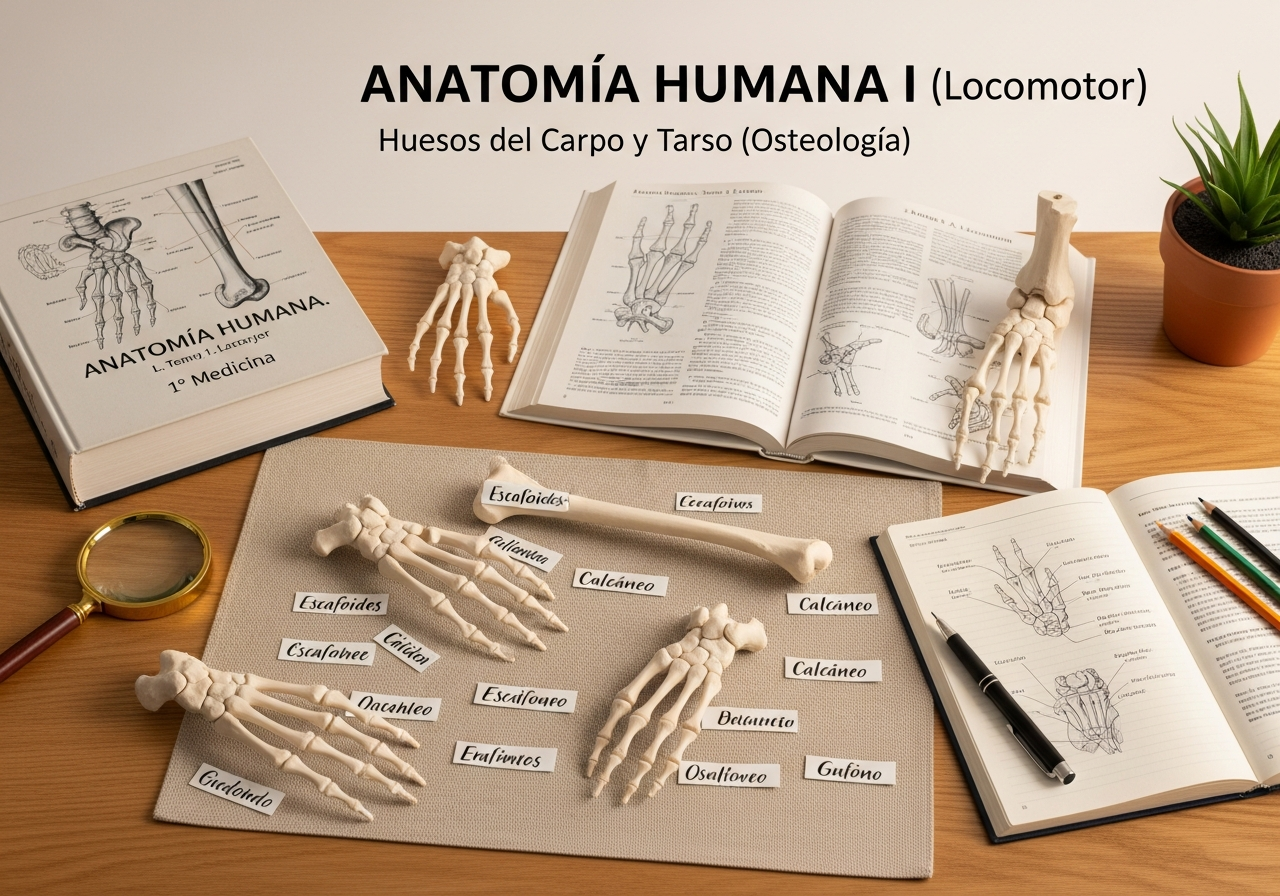
Hey, future doctor! If you're in your 1st year of Med School, you know that the osteology of the carpus and tarsus is a classic tough nut to crack. They're small, numerous, have similar names, and complex joints. The only way to master this topic and not forget it two days later isn't to read it a thousand times, but to test yourself. Active Recall is your best friend. This practice test is designed for you to check if you really have a handle on the material. Let's do this!
Test Yourself: Carpal and Tarsal Bones (Osteology) Quiz
1. Which of the following sequences correctly describes the proximal row of carpal bones, from lateral (thumb side) to medial? a) Scaphoid, Lunate, Triquetrum, Pisiform b) Trapezium, Trapezoid, Capitate, Hamate c) Scaphoid, Trapezium, Capitate, Lunate d) Pisiform, Triquetrum, Lunate, Scaphoid
2. Which tarsal bone is characterized by having no muscle attachments and transmitting the entire body weight from the tibia to the foot? a) Calcaneus b) Talus c) Navicular (Tarsal scaphoid) d) Cuboid
3. The "hook" or uncinate process is a prominent feature of a carpal bone that forms the medial wall of the carpal tunnel and Guyon's canal. Which bone does it belong to? a) Trapezium b) Pisiform c) Hamate d) Capitate
4. What structure of the calcaneus acts as a medial bony shelf to support the head of the talus? a) Peroneal trochlea b) Major tuberosity c) Calcaneal sulcus d) Sustentaculum tali
5. Which carpal bone is the largest and the first to ossify, articulating with the most bones (7 in total)? a) Lunate b) Scaphoid c) Capitate d) Hamate
6. The navicular bone (or tarsal scaphoid) articulates anteriorly with three bones. Which are they? a) The cuboid and the first two cuneiforms b) The three cuneiforms (medial, intermediate, and lateral) c) The talus, the cuboid, and the lateral cuneiform d) The calcaneus and the medial and intermediate cuneiforms
7. Fracture of the carpal scaphoid is the most common carpal fracture. What is its main risk or complication due to its retrograde blood supply? a) Accelerated radio-carpal arthritis b) Avascular necrosis of the proximal pole c) Median nerve injury d) Acute carpal tunnel syndrome
8. Which of the following tarsal bones is located on the most lateral part of the distal tarsal row, articulating with the calcaneus posteriorly and with the 4th and 5th metatarsals anteriorly? a) Lateral cuneiform b) Intermediate cuneiform c) Cuboid d) Navicular
9. The pisiform bone is a sesamoid bone found within the tendon of a muscle. Which one? a) Flexor carpi radialis b) Flexor carpi ulnaris c) Palmaris longus d) Flexor digitorum superficialis
10. Chopart's joint (midtarsal joint) is a surgical amputation line in the foot that is made between: a) The tibia/fibula and the talus/calcaneus. b) The talus/calcaneus and the navicular/cuboid. c) The cuneiforms/cuboid and the metatarsals. d) The proximal phalanges and the metatarsals.
How did it go? Below are the answers with explanations. If you missed more than 3, it's a clear sign that you need to thoroughly review your notes before the exam. Anatomy doesn't forgive the details.
Answers and Explanations
1. Answer: a) Scaphoid, Lunate, Triquetrum, Pisiform. Explanation: The proximal row of the carpus is ordered from lateral to medial. A classic mnemonic is "So Long To Pinky": Scaphoid, Lunate, Triquetrum, and Pisiform. The pisiform is considered a sesamoid bone that only articulates with the anterior face of the triquetrum.
2. Answer: b) Talus. Explanation: The talus is unique. It's the link between the leg and the foot, fitting into the tibiotalar joint (ankle mortise). It has no direct muscle origins or insertions; its movement depends on the surrounding bones. This, along with its precarious blood supply, makes it vulnerable.
3. Answer: c) Hamate. Explanation: The hook of the hamate is a fundamental structure you can palpate in the hypothenar region. It protects the ulnar nerve and artery in Guyon's canal and serves as an attachment point for several muscles and ligaments. A classic exam question!
4. Answer: d) Sustentaculum tali. Explanation: The sustentaculum tali (support of the talus) is a medial projection of the calcaneus that forms the floor of the tarsal sinus and is crucial for hindfoot stability, directly supporting the head of the talus.
5. Answer: c) Capitate. Explanation: The Capitate bone is the central pillar of the carpus. It articulates with the scaphoid and lunate (proximally), the trapezoid and hamate (on the sides), and the 2nd, 3rd, and 4th metacarpals (distally). Its size and central position give it great biomechanical importance.
6. Answer: b) The three cuneiforms (medial, intermediate, and lateral). Explanation: The navicular acts as a force distributor. It receives pressure from the head of the talus and transmits it forward to the three cuneiforms, which in turn articulate with the first three metatarsals.
7. Answer: b) Avascular necrosis of the proximal pole. Explanation: The artery that supplies the scaphoid enters through its distal pole. In a fracture at the waist of the bone, the proximal pole can be left without a blood supply, leading to its death (avascular necrosis), a serious complication that hinders healing.
8. Answer: c) Cuboid. Explanation: The cuboid is the most lateral bone of the distal tarsus. It is wedge-shaped and key to the formation of the lateral arch of the foot. It articulates with the calcaneus, the lateral cuneiform, the navicular (sometimes), and the last two metatarsals.
9. Answer: b) Flexor carpi ulnaris. Explanation: The pisiform develops within the tendon of the flexor carpi ulnaris muscle, increasing the lever arm of this muscle at the wrist joint. It's the perfect example of a sesamoid bone in the upper limb.
10. Answer: b) The talus/calcaneus and the navicular/cuboid. Explanation: Chopart's joint separates the hindfoot (talus and calcaneus) from the midfoot (navicular, cuboid, and cuneiforms). It is formed by two joints: the talonavicular and the calcaneocuboid.

Where Students Usually Go Wrong with Carpal and Tarsal Bones (Osteology)
- Mixing up the lateral-medial order: Especially in the carpus. Always remember that "lateral" is the thumb side (radius) and "medial" is the pinky side (ulna). Learn a mnemonic well and repeat it while visualizing an anatomical hand.
- The blood supply of the Scaphoid and Talus: It's not enough to know they can fracture. The "why" behind their risk of avascular necrosis is a higher-level question that sets students apart. Both have a precarious and retrograde blood supply in certain areas.
- The midfoot joints: Knowing which bone articulates with which in the tarsus is a mess. A common mistake is not remembering that the navicular articulates with all three cuneiforms, while the cuboid articulates with the last two metatarsals (4th and 5th). Make simple diagrams to memorize it.
Is Your Exam Different?
This practice test is excellent for testing the fundamental concepts of carpal and tarsal osteology, just as they appear in reference textbooks (Netter, Gray, Moore...).
However, you know perfectly well that every Human Anatomy I professor has their favorite questions, specific details, and quirks that only appear in THEIR class notes or THEIR slides. You won't find those trick questions in a generic online quiz.
This is where Smartests makes a difference. Instead of studying from a generic quiz, upload YOUR own PDF notes on the carpus and tarsus to the platform. Our AI will analyze YOUR material and create a 100% custom quiz, with questions that could come straight from your real exam. It's the smartest way to prepare.
Quick Summary
Today you've reviewed and tested:
- The exact order and location of the 8 carpal bones and 7 tarsal bones.
- The unique features of key bones like the talus (no muscle attachments) and the scaphoid (risk of necrosis).
- The main joints and anatomical landmarks that are often asked about in 1st-year Med School exams.