
Practice Exam: Have You Mastered the Key Differences Between Mitosis and Meiosis?
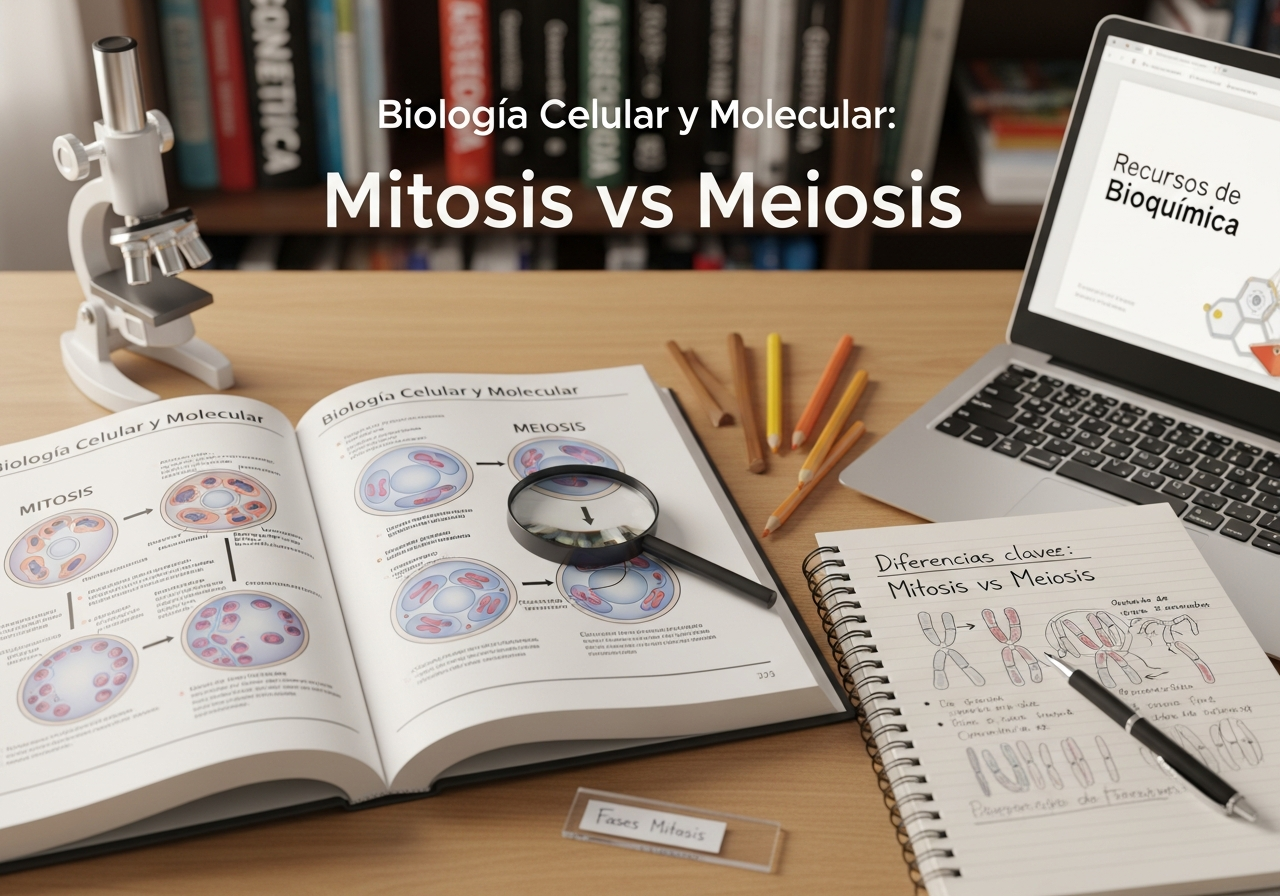
Hey, future doctor! We know that Cell Biology in your first year of med school can be a tough nut to crack, and the distinction between mitosis and meiosis is one of those topics you either master or you gamble on the exam. They're processes with similar names but radically different outcomes and biological purposes. The theory is crucial, but the only way to really lock it in is by putting it to the test. Active Recall is your best friend here. This practice test is designed to make you face the key questions that could show up on your exam. Let's get to it!
Test Yourself: Mitosis vs. Meiosis Quiz
1. What is the characteristic and exclusive event of meiotic Prophase I that does not occur in mitotic Prophase? a) Chromatin condensation. b) Formation of the mitotic spindle. c) Synapsis and crossing over of homologous chromosomes. d) Disappearance of the nuclear envelope.
2. A human somatic cell in G1 has 46 chromosomes. How many sister chromatids will a cell have in the Anaphase of mitosis? a) 46 b) 92 c) 23 d) 0
3. The separation of homologous chromosomes occurs during: a) Anaphase of mitosis. b) Anaphase I of meiosis. c) Anaphase II of meiosis. d) Telophase I of meiosis.
4. Which of the following statements correctly describes the final result of meiosis in humans? a) Two diploid (2n) daughter cells genetically identical to the parent cell. b) Four haploid (n) cells genetically identical to each other. c) Four haploid (n) cells that are genetically distinct due to recombination. d) Two haploid (n) daughter cells that then divide by mitosis.
5. The protein Shugoshin (Sgo1) plays a crucial role in meiosis. What is its main function? a) To initiate chromosome condensation in Prophase I. b) To protect centromeric cohesins from degradation by separase during Anaphase I. c) To facilitate crossing over between homologous chromosomes. d) To activate the Anaphase-Promoting Complex (APC/C).
6. If an organism has a diploid number of 2n=20, how many chromosomes will one of its cells have at the end of Meiosis II? a) 20 chromosomes, each with two chromatids. b) 10 chromosomes, each with one chromatid. c) 10 chromosomes, each with two chromatids. d) 20 chromosomes, each with one chromatid.
7. Nondisjunction (failure to separate) during Meiosis I results in: a) Two normal gametes (n) and two gametes with an extra chromatid. b) 100% of the resulting gametes will be aneuploid (n+1 or n-1). c) One nullisomic gamete (n-1) and three normal gametes. d) Daughter cells with chromosomal mosaicism.
8. How does the orientation of kinetochores in meiotic Metaphase I differ from that in mitotic Metaphase? a) There is no difference; in both cases, the kinetochores of sister chromatids orient to opposite poles. b) In Metaphase I, the kinetochores of sister chromatids orient toward the same pole (syntelic orientation). c) In mitotic Metaphase, kinetochores do not attach to microtubules until anaphase. d) In Metaphase I, only one homologous chromosome of each pair has functional kinetochores.
9. What is the main biological purpose of mitosis in a multicellular organism like a human? a) To produce gametes for sexual reproduction. b) To increase the genetic variability of the population. c) Growth, tissue repair, and cell renewal. d) To halve the number of chromosomes to maintain the species' ploidy.
10. The Synaptonemal Complex is a protein structure that: a) Holds sister chromatids together along their entire length until anaphase. b) Forms between homologous chromosomes during Prophase I to mediate recombination. c) Connects the chromosome kinetochores to the achromatic spindle. d) Is responsible for cytokinesis at the end of telophase.
How did it go? Below are the answers with explanations. If you missed more than 3, you need to review your notes. Cell Biology is unforgiving when it comes to details, and it's precisely in those details that the difference between a pass and a top grade lies.
Answers and Explanations
1. Correct: c) Synapsis and crossing over of homologous chromosomes.
- Explanation: Synapsis (the pairing of homologs) and the subsequent crossing over (exchange of genetic material) are the defining events of Prophase I and are the main source of genetic variability in meiosis. The other events (a, b, d) occur in both mitosis and meiosis.
2. Correct: d) 0
- Explanation: This is a trick question. In mitotic Anaphase, the sister chromatids separate. The moment they separate, they stop being called "chromatids" and are considered complete individual "chromosomes." Therefore, in anaphase, there are 92 chromosomes but 0 sister chromatids.
3. Correct: b) Anaphase I of meiosis.
- Explanation: Meiosis I is known as a "reductional division" precisely because in Anaphase I, the homologous chromosomes separate, one moving to each pole. In mitotic Anaphase and meiotic Anaphase II, it's the sister chromatids that separate.
4. Correct: c) Four haploid (n) cells that are genetically distinct due to recombination.
- Explanation: Meiosis consists of two divisions that reduce the ploidy (from 2n to n) and generate four cells. Crossing over in Prophase I and the random segregation of homologs in Anaphase I ensure that these four cells (gametes) are genetically unique.
5. Correct: b) To protect centromeric cohesins from degradation by separase during Anaphase I.
- Explanation: For homologous chromosomes to separate while sister chromatids remain attached in Anaphase I, the cohesin at the centromere must be protected. Shugoshin is the key protein that envelops the centromere and prevents separase from degrading the cohesin at that specific location until Anaphase II.
6. Correct: b) 10 chromosomes, each with one chromatid.
- Explanation: Meiosis I reduces the chromosome number by half (from 2n=20 to n=10). Meiosis II is an equational division, similar to mitosis, where sister chromatids separate. Therefore, at the end, each of the 4 daughter cells will have n=10 chromosomes, and each of them will consist of a single chromatid.
7. Correct: b) 100% of the resulting gametes will be aneuploid (n+1 or n-1).
- Explanation: If a pair of homologs fails to separate in Meiosis I, one daughter cell will receive both homologs and the other will receive none. When these two cells undergo Meiosis II, the first will generate two (n+1) gametes and the second will generate two (n-1) gametes. Therefore, all products are abnormal. Nondisjunction in Meiosis II would only affect 50% of the gametes.
8. Correct: b) In Metaphase I, the kinetochores of sister chromatids orient toward the same pole (syntelic orientation).
- Explanation: This is a fundamental mechanism. For homologs to separate in Anaphase I, the microtubules from one pole must capture BOTH sister chromatids of a homologous chromosome. In mitosis (and Meiosis II), the kinetochores of sister chromatids orient to opposite poles (amphitelic orientation) to allow for their subsequent separation.
9. Correct: c) Growth, tissue repair, and cell renewal.
- Explanation: Mitosis is the process of division for somatic cells. Its function is to produce genetically identical cells for the organism to grow, replace damaged cells (e.g., in a wound), or old cells (e.g., in the intestinal epithelium). The production of gametes (a) and variability (b) are functions of meiosis.
10. Correct: b) Forms between homologous chromosomes during Prophase I to mediate recombination.
- Explanation: The Synaptonemal Complex is a "zipper-like" protein structure that precisely aligns homologous chromosomes during the pachytene stage of Prophase I, stabilizing them so that crossing over can occur effectively.
Where Students Usually Go Wrong with Mitosis vs. Meiosis
Even the best students stumble. In our experience, these are the 3 most common tricky concepts on Med School exams:
- Confusing what separates in each Anaphase: This is the most common mistake. Burn this into your brain: Anaphase I (Meiosis) -> HOMOLOGS separate. Anaphase (Mitosis) and Anaphase II (Meiosis) -> CHROMATIDS separate. Visualizing the diagrams is key here.
- The Chromosome vs. Chromatid count: They are not the same thing. A chromosome can have one or two chromatids. Knowing how to count the genetic material in each phase (e.g., 46 chromosomes/92 chromatids in mitotic Metaphase vs. 23 chromosomes/46 chromatids in Metaphase II) is vital. Question 2 on this quiz is a classic example of this.
- The origin of genetic variability: Many answer "meiosis" but can't specify the two mechanisms: 1) Homologous recombination (crossing over) in Prophase I and 2) Independent assortment of homologous chromosomes in Anaphase I. A good professor will ask you for the exact mechanisms.
Is Your Exam Different?
This practice test is based on the fundamental principles of Cell Biology that you'll find in any standard textbook (like Alberts or Lodish). It's an excellent foundation.
However, your professor/exam board surely has their own quirks and specific questions that aren't on the internet. Maybe they focus more on regulation by cyclins and CDKs, on the proteins of the synaptonemal complex, or on specific pathologies derived from nondisjunction. Your class slides and notes are the most valuable source of information you have.
That's where this generic test falls short. What if you could have a quiz like this, but generated 100% from YOUR own notes?
Upload your Mitosis and Meiosis PDF to Smartests and let our AI analyze your professor's focus and generate a custom exam from YOUR material. You'll practice exactly what you're going to be asked, without wasting time on information that isn't on your syllabus.
Quick Summary
Today we've tested your knowledge and you've learned that:
- The fundamental difference between mitosis and meiosis lies in the pairing and separation of homologous chromosomes and in the reduction of ploidy, which are exclusive to meiosis.
- The genetic variability generated in meiosis isn't magic; it's due to specific mechanisms like crossing over in Prophase I and independent assortment.
- Molecular concepts like the role of Shugoshin or the orientation of kinetochores are what distinguish a student who understands the process from one who just memorizes the phases.