
Construction Materials Quiz: Ace the Key Civil Engineering Course at UPM

If you're studying for a Civil Engineering degree at the Polytechnic University of Madrid (UPM), there's one word that surely echoes in the hallways: Materials. "Construction Materials" isn't just another course; it's the foundation upon which you'll (literally) build your entire future as an engineer.
From understanding why concrete has a specific strength to knowing the ideal type of steel for a beam, this subject is everything. But let's be honest, it can also be a real beast. The amount of data, classifications, and properties to memorize is huge.
What if there was a smarter way to tackle it? Keep reading, because we're going to show you how you can test your knowledge and, most importantly, how you can study in a much more active and effective way.
What makes "Materials" at UPM so special?
The Construction Materials course at UPM's School of Civil Engineering (ETSI de Caminos, Canales y Puertos) is fundamental. It's not just theory; it's the direct link between science and the construction site. Here, you learn the "why" behind things: the chemical composition of cement, the behavior of aggregates, or the mechanical properties of metals.
The syllabus is usually dense and covers a ton of areas:
- Binders and Concrete: A civil engineer's bread and butter. Types of cement, additives, the setting process, durability...
- Metallic Materials: Mainly steel, its alloys, stress-strain diagrams, corrosion, and protection.
- Ceramic and Stone Materials: Bricks, tiles, natural rocks, and their applications.
- Other materials: Wood, polymers, bituminous materials…
The challenge is that memorization isn't enough. You have to connect concepts and understand how materials interact with each other and the environment. That's why multiple-choice exams are a classic for this course, because they force you to have a very, very clear understanding.

Test Yourself: A Quick Construction Materials Quiz
Dare to see how you're doing with some basic concepts? Here's a short, general quiz to give you an idea. No peeking at your notes!
1. Which of the following compounds is primarily responsible for the initial strength of Portland cement? a) Dicalcium silicate (C2S) b) Tricalcium silicate (C3S) c) Tricalcium aluminate (C3A) d) Tetracalcium aluminoferrite (C4AF)
2. In a tensile test of a rebar steel rod, which point on the stress-strain diagram marks the beginning of plastic deformation? a) Proportionality limit b) Elastic limit c) Ultimate tensile strength d) Young's modulus
3. What is the main function of a superplasticizer additive in a concrete mix? a) To accelerate the setting time. b) To increase resistance to freeze-thaw cycles. c) To reduce the amount of mixing water while maintaining the same workability. d) To delay the hydration of the cement.
4. According to its particle size distribution, how is an aggregate classified if its particles pass through a 4 mm sieve? a) Gravel b) Sand c) Silt d) Filler
5. The phenomenon of corrosion in steel reinforcement in concrete is mainly promoted by: a) A very alkaline pH of the concrete. b) The presence of chlorides and carbonation. c) High compactness of the concrete. d) The use of high-carbon steels.
6. What property does the "Abrams cone" (slump test) measure in fresh concrete? a) Density. b) Entrained air content. c) Consistency or workability. d) Compressive strength at 1 day.
Correct answers: 1-b, 2-b, 3-c, 4-b, 5-b, 6-c
How did it go? If you got most of them right, congratulations! You're on the right track. If you missed a few, don't worry, that's totally normal. In fact, you've just discovered something you need to review. And that, my friend, is studying smart.

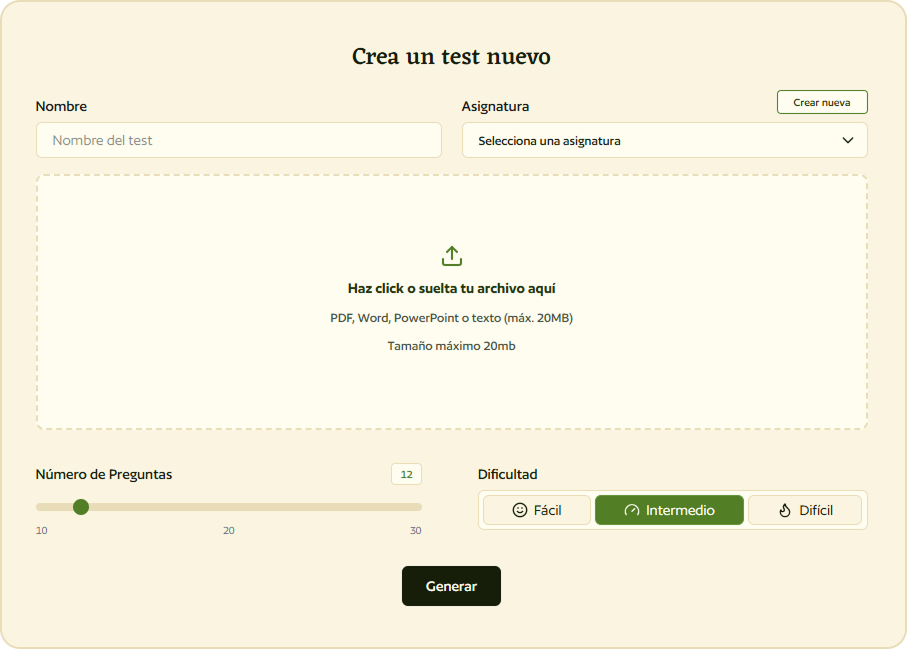
Imagine being able to do this, but with ANY part of your syllabus. Smartests.app turns your notes into multiple-choice tests in seconds. Just upload your PDF with the theory on steel or your notes on additives, and the AI creates a custom quiz for you to practice exactly what you need.
Sounds good, right?
The problem with generic tests (and how to solve it)
The quiz you just took is useful, but it has one big problem: it's generic.
Maybe your professor emphasizes durability more than the types of cement. Or perhaps in class, you've gone deep into polymeric materials, something this quiz doesn't even mention.
Studying with random tests from the internet is like shooting in the dark. You might review concepts you already master and leave out exactly what your professor considers most important. The key to passing (and to truly learning) is personalization.
You need a tool that works for you, that adapts to your study materials. The goal isn't to answer a thousand questions, but to answer the right questions: the ones that come from your own notes. This is where technology can give you a hand.
Quick Summary
If you take away one thing from this post, let it be this:
- Materials is key: It's a fundamental course in Civil Engineering at UPM, but its density makes it difficult.
- Study actively: Don't just read and highlight. Constantly test yourself to find your weak spots.
- Quizzes are your allies: They force you to recall details and differentiate between very similar concepts, which is typical in "Materials" exams.
- Personalization wins: Don't waste time on generic tests. Focus on what you've covered in class, on your own notes.
Pass Materials with your own tests
Stop searching for generic exams or relying on other people's notes. The most direct way to pass is to master your own study material.
Smartests creates unique, personalized multiple-choice quizzes from your PDF notes. Upload the topic you want to review, and in less than a minute, you'll have a quiz ready to practice. It's that simple. Turn hours of passive studying into real, effective practice.