
Human Anatomy II Exam: Have You Mastered the Origin and Function of the Cranial Nerves?
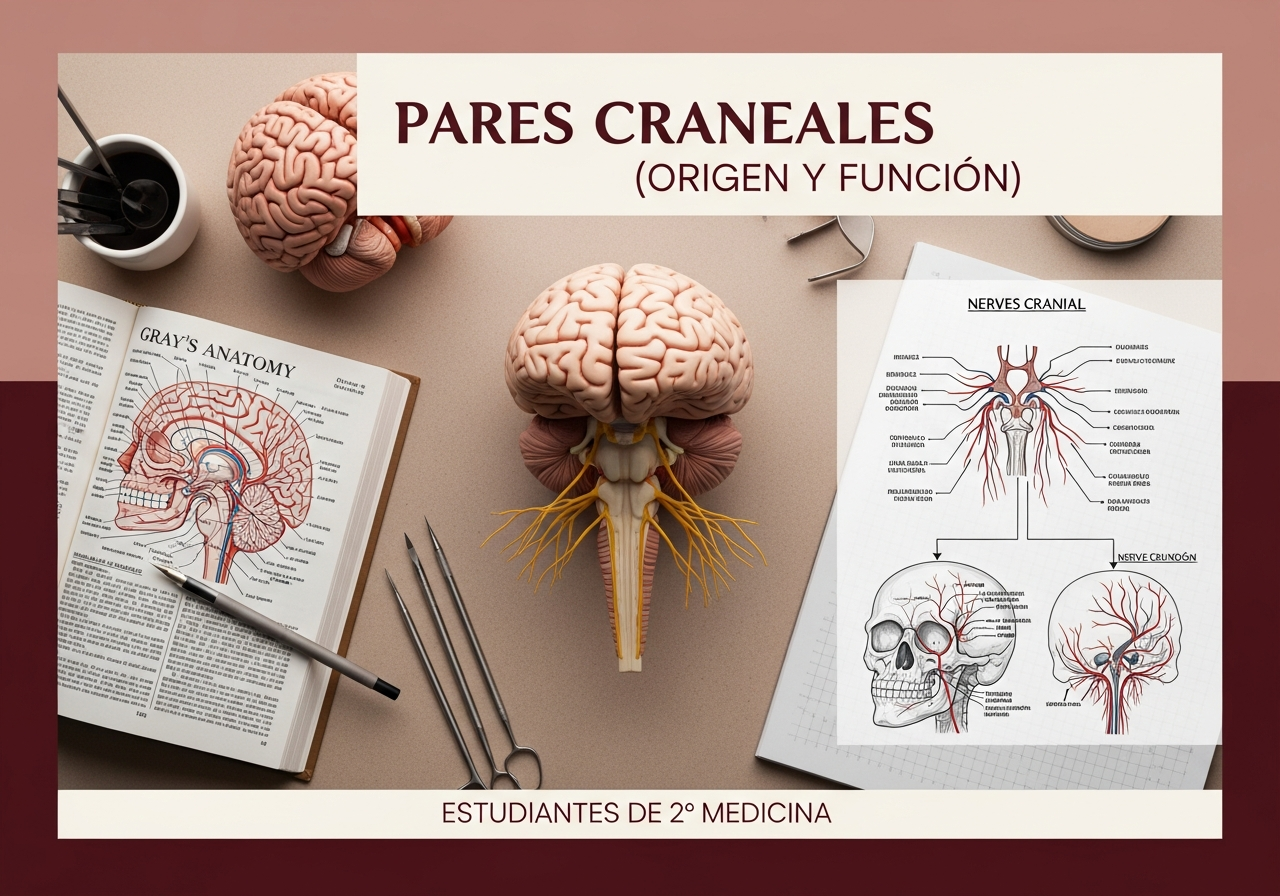
Hey, future doctor. I know the Cranial Nerves can be a real headache in Human Anatomy II. Remembering their apparent and real origins, their motor, sensory, and parasympathetic functions, and their pathways is a monumental challenge. But, as you already know, the best way to lock in this knowledge isn't by rereading over and over, but by actively testing yourself (Active Recall). This practice exam is designed for just that: to help you identify your weak spots before the big day. Are you ready?
Test Yourself: Cranial Nerves Quiz (Origin and Function)
1. A patient presents with miosis and difficulty with lens accommodation. The lesion likely affects the parasympathetic component of a cranial nerve, whose real origin is found in: a) The superior salivatory nucleus. b) The Edinger-Westphal nucleus. c) The dorsal nucleus of the vagus. d) The nucleus ambiguus.
2. What is the real origin of the sensory fibers (exteroceptive sensitivity) of the Trigeminal nerve (V)? a) The trigeminal nuclei in the brainstem. b) The mesencephalic nucleus of the trigeminal. c) The Gasserian (or trigeminal) ganglion. d) The geniculate ganglion.
3. A lesion of the Chorda Tympani nerve, a branch of the VII cranial nerve, would primarily cause: a) Paralysis of the muscles of facial expression. b) Loss of sensation in the posterior third of the tongue. c) Hyperacusis (abnormal sensitivity to sound). d) Loss of taste in the anterior two-thirds of the tongue and impaired submandibular/sublingual secretion.
4. The nucleus that gives rise to most of the preganglionic parasympathetic fibers of the Vagus nerve (X) to innervate the thoracic and abdominal viscera is: a) The nucleus ambiguus. b) The nucleus of the solitary tract. c) The dorsal nucleus of the vagus. d) The inferior salivatory nucleus.
5. Of the following cranial nerves, which one has an exclusively somatic motor function? a) Facial nerve (VII). b) Glossopharyngeal nerve (IX). c) Abducens nerve (VI). d) Trigeminal nerve (V).
6. The gag reflex (or pharyngeal reflex) depends on an afferent and an efferent pathway. Which cranial nerve is primarily responsible for the afferent (sensory) pathway of this reflex? a) Vagus nerve (X). b) Glossopharyngeal nerve (IX). c) Hypoglossal nerve (XII). d) Facial nerve (VII).
7. What is the apparent origin of the Trigeminal nerve (V) in the brainstem? a) In the pontomedullary sulcus, medial to VII and VIII. b) On the anterolateral surface of the pons. c) On the anterior surface of the midbrain, in the interpeduncular fossa. d) Lateral to the medullary olives.
8. Unlike most cranial nerves, the real origin of the Olfactory nerve (I) is found in: a) The olfactory bulb. b) The piriform cortex. c) The bipolar cells of the olfactory mucosa. d) The anterior olfactory nucleus.
9. The distinctive anatomical feature of the Accessory nerve (XI) regarding its origin is that: a) It is the only nerve that originates entirely in the midbrain. b) It has a dual origin: a cranial (bulbar) root and a spinal root. c) It originates in the spiral ganglion of the inner ear. d) It is purely sensory.
10. A patient comes to the ER after a head injury. On examination, their right eyeball is deviated "down and out" and they have mydriasis. Which cranial nerve is most likely injured? a) Trochlear nerve (IV). b) Abducens nerve (VI). c) Optic nerve (II). d) Oculomotor nerve (III).
How did it go? Below are the answers with explanations. If you missed more than 3, you need to review your notes thoroughly before the exam.
Answers and Explanations
-
Correct Answer: b) The Edinger-Westphal nucleus.
- Explanation: This nucleus is the real origin of the parasympathetic fibers of the III cranial nerve (Oculomotor nerve). These fibers are responsible for the contraction of the sphincter pupillae muscle (miosis) and the ciliary muscle (lens accommodation).
-
Correct Answer: c) The Gasserian (or trigeminal) ganglion.
- Explanation: The Gasserian ganglion houses the cell bodies of the first-order neurons for general sensation (touch, pain, temperature) of the face. Their axons form the sensory root of the V nerve, while the brainstem nuclei are the second-order destination.
-
Correct Answer: d) Loss of taste in the anterior two-thirds of the tongue and impaired submandibular/sublingual secretion.
- Explanation: The Chorda Tympani nerve carries two important types of fibers from the Facial nerve (VII): taste fibers for the anterior 2/3 of the tongue and preganglionic parasympathetic fibers for the submandibular and sublingual salivary glands.
-
Correct Answer: c) The dorsal nucleus of the vagus.
- Explanation: This is the main parasympathetic nucleus of the Vagus nerve (X). Its axons provide parasympathetic innervation to almost all viscera of the thorax and abdomen up to the splenic flexure of the colon. The nucleus ambiguus provides motor fibers for the pharynx and larynx.
-
Correct Answer: c) Abducens nerve (VI).
- Explanation: The Abducens nerve (VI) only innervates the lateral rectus muscle of the eye, making it purely somatic motor. The Facial (VII), Glossopharyngeal (IX), and Trigeminal (V) nerves are mixed nerves, with motor, sensory, and/or parasympathetic components.
-
Correct Answer: b) Glossopharyngeal nerve (IX).
- Explanation: The IX nerve is responsible for collecting sensation from the posterior third of the tongue and the oropharynx, which constitutes the afferent stimulus for the gag reflex. The motor response (efferent) is carried mainly by the Vagus nerve (X).
-
Correct Answer: b) On the anterolateral surface of the pons.
- Explanation: The apparent origin of the Trigeminal nerve is a key anatomical landmark. It emerges from the anterolateral surface of the pons via two roots: a large sensory root and a smaller motor root.
-
Correct Answer: c) The bipolar cells of the olfactory mucosa.
- Explanation: Unlike the others, which originate in brainstem nuclei, the first-order neurons of the I cranial nerve are the receptor cells themselves, located in the epithelium of the olfactory mucosa at the roof of the nasal cavities.
-
Correct Answer: b) It has a dual origin: a cranial (bulbar) root and a spinal root.
- Explanation: The XI nerve is unique. Its spinal root originates in the first cervical spinal segments (C1-C5) and ascends to enter the skull, innervating the sternocleidomastoid and trapezius muscles. The cranial root originates in the nucleus ambiguus and joins the vagus nerve.
-
Correct Answer: d) Oculomotor nerve (III).
- Explanation: A lesion of the III nerve paralyzes most of the extrinsic eye muscles. The unopposed action of the lateral rectus (innervated by VI) and the superior oblique (innervated by IV) causes the characteristic "down and out" deviation of the eye. Mydriasis is due to the involvement of its parasympathetic fibers.

Where Students Usually Go Wrong with Cranial Nerves (Origin and Function)
- Confusing Real and Apparent Origin: The apparent origin is the visible point where the nerve emerges from the brainstem. The real origin is the gray matter nuclei (groups of neurons) where the fibers originate or terminate. Examiners love to ask about the specific nuclei (real origin).
- The division of functions between VII, IX, and X: These three nerves have overlapping functions in the pharynx, taste, and glandular secretion. The key is to associate: VII with facial expression and taste in the anterior 2/3; IX with the stylopharyngeus muscle, the parotid gland, and sensation/taste in the posterior third; and X with motor control of the pharynx/larynx and massive visceral parasympathetic innervation.
- Forgetting the parasympathetic components: Only four cranial nerves carry parasympathetic fibers: III (Oculomotor), VII (Facial), IX (Glossopharyngeal), and X (Vagus). Remembering this group (the "3, 7, 9, and 10" rule) and the nucleus associated with each is crucial and a classic exam question.
Is Your Exam Different?
This practice test is based on standard Human Anatomy II literature, like Gray's, Moore's, or Netter's textbooks. These are high-yield questions that are likely to appear on any exam.
However, the anatomy that shows up on an exam isn't always straight from the textbook. Your professor has their own slides, recurring questions, and favorite details they repeat in class that you won't find in a generic online quiz.
That's where a generic quiz falls short. The only way to train for YOUR exam is to practice with YOUR material. Upload your notes or the PDF for the "Cranial Nerves" topic to Smartests and let our AI create a custom quiz for you, using the exact terminology and concepts your professor wants you to know. Don't study more, study smarter.
Quick Summary
Today you've reviewed and tested yourself on three vital concepts about the Cranial Nerves:
- The critical difference between the real origin (nuclei) and the apparent origin (emergence from the brainstem).
- The specific distribution of parasympathetic functions in nerves III, VII, IX, and X.
- How a specific lesion (clinical case) allows you to deduce the function and the affected cranial nerve.