
Test Your 2nd Year Bachillerato Spanish History Knowledge: Can You Pass This Quiz?
Spanish History in 2nd Year Bachillerato. Just reading that is a little intimidating, right? It's one of those key subjects—dense and packed with dates, names, and processes that seem never-ending. The syllabus is an intense journey from the crisis of the Old Regime in the 19th century to the present day.
You know what I'm talking about: the War of Independence, the Cortes of Cádiz, the reign of Isabella II, the Sexenio Democrático, the Restoration, the Second Republic, the Civil War, the Franco regime, and the Transition to democracy. No big deal.
To tackle this, rote memorization isn't enough. You have to understand, connect the dots, and, above all, test what you know. And for that, multiple-choice exams are an awesome tool. Shall we try a quick one?
Tip: After taking the quiz, you can calculate your score with the multiple-choice test score calculator
Mini Quiz: How Much Do You Know About Spanish History?
Here's a short quiz with questions that could appear on your university entrance exam (EBAU/EvAU). Grab a pen and paper, jot down your answers, and then check the results. Let's do this!
1. What treaty allowed Napoleonic troops to enter Spain, marking the beginning of the War of Independence? a) Treaty of Tordesillas b) Treaty of Utrecht c) Treaty of Fontainebleau d) Family Compacts
2. During the Bourbon Restoration, the political system devised by Cánovas del Castillo was based on: a) Universal male suffrage and anarchy. b) The arranged alternation of power between the Conservative Party and the Liberal Party. c) A single-party system led by the king. d) The proclamation of the Third Republic.
3. The Constitution of 1931, enacted during the Second Republic, is considered one of the most progressive of its time because, among other things, it included: a) The exclusive official status of the Catholic religion. b) The prohibition of political parties. c) Women's suffrage. d) The restoration of the monarchy as the form of government.
4. What event is considered the main trigger of the Spanish Civil War in 1936? a) The victory of the Popular Front in the February elections. b) The proclamation of the Second Republic. c) The assassination of José Calvo Sotelo. d) The military uprising of July 17th and 18th.
5. The "Moncloa Pacts" of 1977 were agreements signed during the Transition with the main objective of: a) Drafting a new Constitution. b) Stabilizing the economy and consolidating democracy. c) Legalizing the Communist Party of Spain. d) Organizing a referendum on the monarchy.
6. What characterized the economic policy of early Francoism (autarky)? a) Complete openness to international markets. b) Economic self-sufficiency and isolation from the outside world. c) Economic dependence on the Soviet Union. d) Joining the European Economic Community.
7. The "Disaster of '98" refers to: a) A severe economic crisis in Spain. b) The loss of the last overseas colonies: Cuba, Puerto Rico, and the Philippines. c) The end of the First Carlist War. d) The abdication of King Amadeo I of Savoy.
The Correct Answers (No cheating!)
Ready to see how you did? Here are the solutions:
- c) Treaty of Fontainebleau (1807): Signed between Spain and France, it allowed French troops to pass through Spanish territory to, theoretically, invade Portugal. It was the perfect excuse for the Napoleonic occupation.
- b) The arranged alternation of power between the Conservative Party and the Liberal Party: This system, known as "turnismo," guaranteed stability through peaceful alternation, although it was often achieved through electoral fraud (pucherazo).
- c) Women's suffrage: The 1931 Constitution was a pioneer in recognizing women's right to vote in Spain, in addition to establishing a secular state and broad social rights.
- d) The military uprising of July 17th and 18th: Although the political climate was very tense, the coup d'état led by a group of military officers was the event that started the war.
- b) Stabilizing the economy and consolidating democracy: These were crucial agreements between the government, the main political parties, and trade unions to address the severe economic and social crisis, laying the foundations for the new democracy.
- b) Economic self-sufficiency and isolation from the outside world: After the Civil War and in the context of World War II, Franco's regime opted for an autarkic model that sought to produce everything needed internally, with very poor economic results.
- b) The loss of the last overseas colonies: The defeat in the war against the United States in 1898 was a profound moral, political, and intellectual shock in Spain, sparking the Regenerationism movement.
The Problem with a Generic Quiz (And How to Solve It)
How did you do? Maybe you got most of them right, or perhaps a question caught you by surprise. Either way, this quiz has a problem: it's too generic.
Think about your classes. Your teacher probably emphasizes certain aspects, uses specific examples, or follows the structure of a particular textbook. A quiz you find online doesn't know any of that. It doesn't know your notes, nor the ideas your teacher considers most important.
So, how can you practice with the content that actually will be on your exam? The answer is in your own notes.
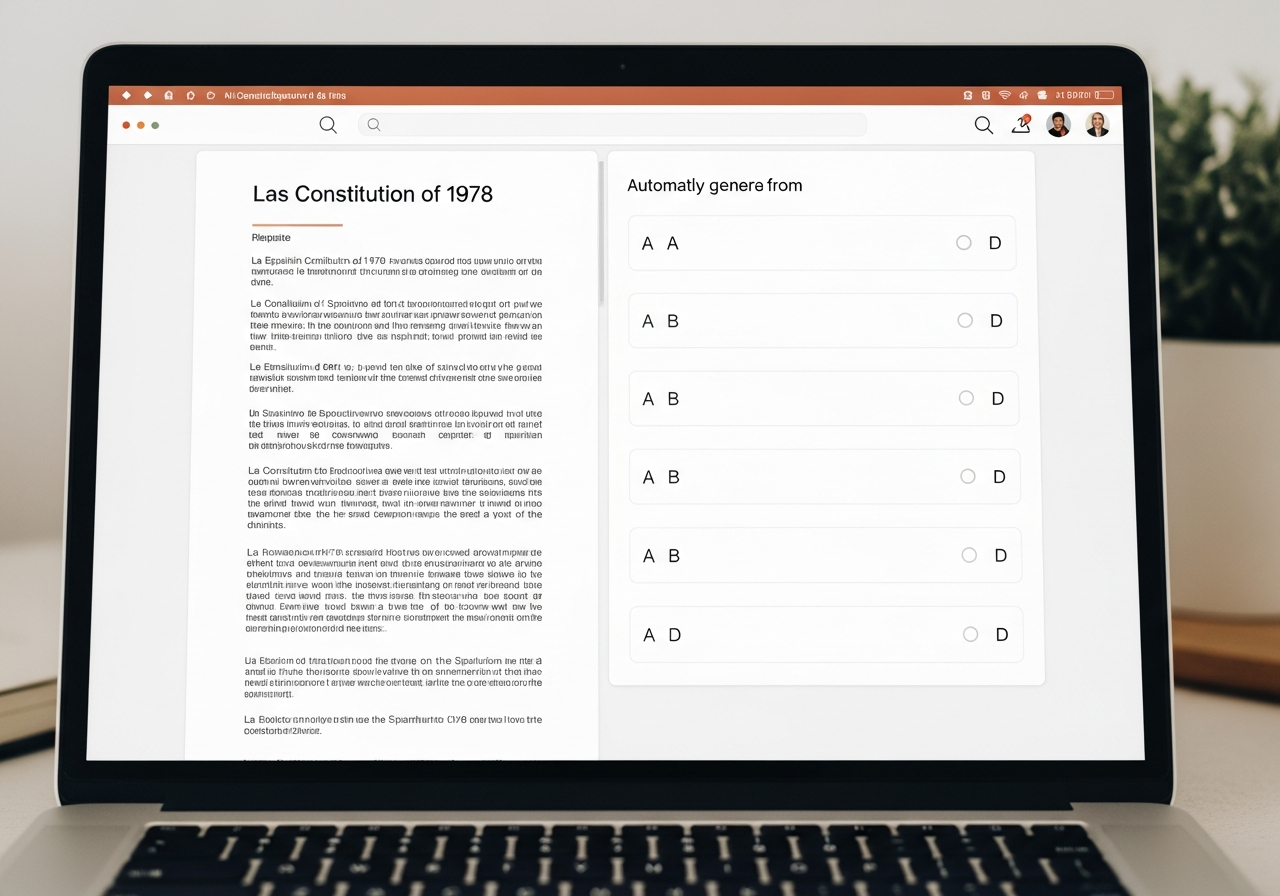
This is where things get interesting. What if you could turn your notes on the Restoration or your outlines on the Civil War into a custom multiple-choice quiz with just a couple of clicks? That's exactly what Smartests.app does. You upload your document, and our AI generates a quiz based exclusively on your study material.
This way, you ensure you're reviewing what really matters, without wasting time on questions that have nothing to do with what you've covered in class.
Create your custom quizzes here
The Key: Study What Really Matters
Neuroscience confirms it: one of the most effective ways to learn and retain information is through retrieval practice (or active recall). That is, actively trying to remember information instead of just re-reading it. Multiple-choice quizzes are a perfect way to do this.
But for it to be truly effective, you have to practice with the right material. It's useless to memorize details from an online quiz if your actual exam focuses on the concepts your teacher explained in class and that you have in your notes.
Studying smart isn't about putting in more hours, but about using the hours you have as efficiently as possible. It's about focusing on your weaknesses, reinforcing what you already know, and, above all, practicing in a way that simulates the real exam.
Quick Summary
If you got lost among all the dates and constitutions, here's the gist:
- 2nd Year Bachillerato History is dense: It covers two centuries of radical change in Spain.
- Quizzes are a top-notch tool: They help you review and actively lock in knowledge.
- A generic quiz isn't enough: It's a good starting point, but it doesn't adapt to your notes or what your teacher considers important.
- The key is to practice with your own material: Your notes are the source of truth for your exams.
- Smartests.app automates this process: It turns your notes into custom quizzes so you can study faster and more effectively.
Stop Searching for Quizzes, Create Them Yourself
Ready to stop searching for generic quizzes and start practicing with what really counts? Smartests.app turns your notes into multiple-choice quizzes so you can study smarter, not harder. Upload your notes and see for yourself how you can master Spanish History.