
How to Calculate Your Multiple-Choice Test Score: The Ultimate Guide

You walk out of the exam. It's a bittersweet feeling. You think it went well, but you're not sure. And then the nagging thoughts start buzzing in your head: "How many did I get wrong? What about the ones I left blank? How many points will I lose for my mistakes?".
Multiple-choice tests have their own logic. It's not just about adding up the right answers; wrong ones are usually penalized. Understanding how that system works is key, not just for calculating your score, but also for deciding whether to risk answering a question or just leave it blank.
Don't worry, you don't need a master's degree in math. Today, we're going to explain in a super simple way how the system works, what the magic formula is for calculating your score, and, just in case math isn't your thing, we'll give you a tool to do it with a single click.
Why Do Wrong Answers Cost You Points on a Multiple-Choice Test?
You've probably asked yourself this a thousand times. Isn't it enough to just not get the point? Why do they have to take points away on top of that?
The answer is simple: to discourage random guessing.
If incorrect answers weren't penalized, the smartest thing to do would be to answer every question, even the ones you have no clue about. By pure probability, you'd get some right and your score would go up. By penalizing mistakes, the test aims to measure what you actually know, not how lucky you are at guessing.
The goal is for you to only answer when you have real knowledge or, at the very least, a well-founded hunch about the correct answer.
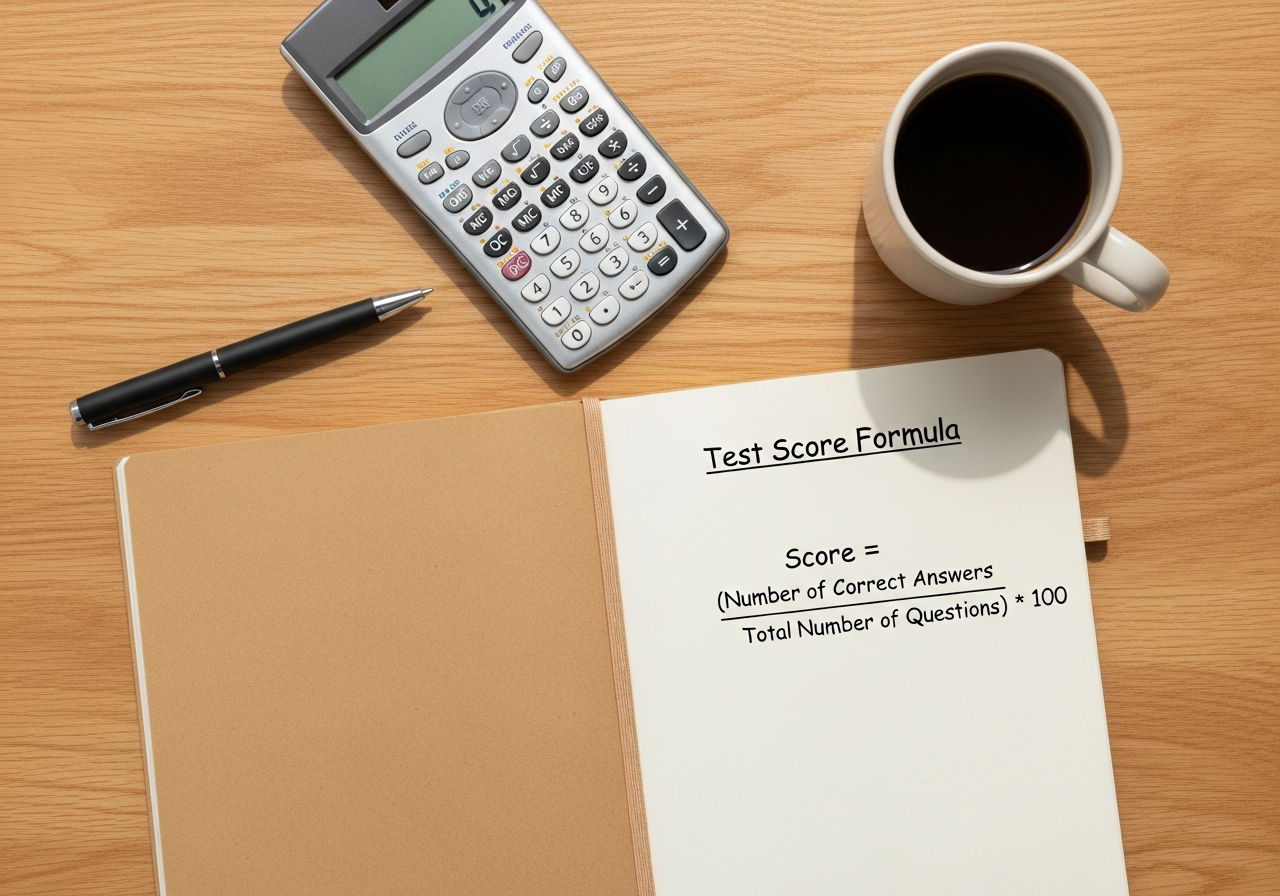
The Formula to Calculate Your Score (and Finally Understand It)
Okay, let's get into it. While it might seem intimidating, the formula is quite logical. You just need to have a few key pieces of information about your test.
The general formula is this:
Final Score = [Correct Answers - (Wrong Answers / (Number of Options - 1))] x (Max Score / Total Number of Questions)
Let's break this down so there's no confusion:
- Correct Answers: The number of questions you answered correctly. Easy.
- Wrong Answers: The number of questions you answered incorrectly.
- Number of Options: The number of answer choices for each question (usually 3, 4, or 5). This piece of info is crucial because it determines how much each wrong answer is penalized. If there are 4 options, each mistake deducts 1/3 (or 0.33 points). If there are 3 options, each mistake deducts 1/2 (0.5 points).
- Max Score: The highest possible score on the test (usually 10).
- Total Number of Questions: The total number of questions on the test.
What's inside the brackets [...] gives you your net score of correct answers. Then, that score is adjusted to the test's scale (usually out of 10) with the second part of the formula.
Let's Put the Formula to the Test: Time for Some Examples!
Seeing it with numbers always helps make it clearer. Let's imagine two typical scenarios.
Example 1: Civil Service Exam with 4 Options
Imagine you take a 90-question exam, with 4 answer options per question, and the maximum score is 10.
- Total Number of Questions: 90
- Number of Options: 4
- Max Score: 10
- Your results: 65 correct, 15 wrong, and 10 blank questions.
Let's apply the formula:
- Calculate the penalty for wrong answers:
15 / (4 - 1)=15 / 3= 5. Your 15 mistakes cost you 5 net points. - Calculate the net score:
65 Correct Answers - 5 (penalty)= 60. - Adjust to the final score:
60 x (10 / 90)=60 x 0.111...= 6.67.
Your final score on the exam would be 6.67. Not bad at all!
Understanding this formula gives you power, but the real key to passing is practice. A lot of it. Can you imagine being able to turn those notes you have in Word or PDF into unlimited multiple-choice tests to practice non-stop?
That's exactly what Smartests.app does. You upload your notes, and our AI creates tests in seconds so you can test your knowledge, identify your weak spots, and walk into the exam with unshakable confidence.
Example 2: University Exam with 3 Options
Now for a shorter exam, from a university course. It has 40 questions, with 3 answer options each, and it's scored out of 10.
- Total Number of Questions: 40
- Number of Options: 3
- Max Score: 10
- Your results: 30 correct, 8 wrong, and 2 blank.
Let's do the math:
- Calculate the penalty for wrong answers:
8 / (3 - 1)=8 / 2= 4. Your 8 mistakes cost you 4 net points. - Calculate the net score:
30 Correct Answers - 4 (penalty)= 26. - Adjust to the final score:
26 x (10 / 40)=26 x 0.25= 6.5.
In this case, your score would be 6.5. As you can see, with fewer answer options, the penalty for each mistake is higher.

The Easy Solution: Our Multiple-Choice Score Calculator
We know that after an exam, the last thing you want to do is crunch numbers. You want a quick, reliable answer to calm your nerves (or to start celebrating).
That's why we created a tool that does all this work for you.
On our website, you'll find a completely free Multiple-Choice Test Score Calculator. You just have to enter the data we've already covered (correct answers, wrong answers, total questions, etc.), and it will give you your score instantly.
✅ It's free ✅ It's super easy to use ✅ It saves you time and potential calculation errors
You can access it right now and save it to your bookmarks to always have it handy.
👉 Try it here: https://www.smartests.app/calculadora-examenes-test
Quick Summary
If you just want the key takeaways, here they are:
- Wrong answers are penalized to prevent random guessing and to reward those who actually know the answer.
- The key formula is:
Score = [Correct Answers - (Wrong Answers / (Number of Options - 1))] * (Max Score / Total Number of Questions). - The number of options per question is fundamental, as it changes how much each mistake is penalized.
- If you don't want to deal with the hassle, use our free online calculator and get your answer in seconds.
Pass Your Tests Without the Stress
Calculating your score is important, but it's even more important to prepare well to get the highest score possible. The key to multiple-choice tests isn't memorization, but understanding and practice.
With Smartests.app, you can transform your notes into an active study tool. Stop just reading and re-reading, and start practicing with unlimited tests tailored just for you. It's the smartest way to study and lock in that passing grade.