
How to Improve Your Concentration While Studying (and Stop Wasting Time)

You sit down to study. You open your notes, your book, your laptop. You have every intention of making the most of the afternoon. And then suddenly, without knowing how, 45 minutes have passed, and all you've done is check your phone three times, think about dinner, and arrange your pens by color.
Sound familiar? A lack of concentration is the number one enemy of any student. But the good news is, it's not a losing battle. It's not about having superhuman willpower, but about using the right strategies.
In this post, we're going to give you practical, straightforward tips to help you truly concentrate, study more efficiently, and, while you're at it, get back some time to do whatever you want.
1. Your Environment is Key: Prep Your Study Zone
Imagine trying to sleep in a nightclub. Impossible, right? Well, trying to study in a chaotic environment is similar. Your brain needs the right signals to understand that it's time to concentrate.
- Tidy your desk: A clear space helps create a clear mind. Get rid of everything you don't need for the task at hand.
- Your phone, your greatest enemy: Let's be honest, it's the biggest source of distraction. The best solution is the simplest one: put it in another room. If you need it to look something up, put it on "Do Not Disturb" mode and place it face down, out of your direct line of sight.
- Light and comfort: Make sure you have good lighting and a comfortable chair. These are small details that make a huge difference in the long run.
A space prepared for studying tells your brain: "Okay, let's do this."

2. Work in Sprints: The Pomodoro Technique
Studying for hours on end is not only exhausting, it's counterproductive. Your attention span is limited. The solution is to work with it, not against it.
The Pomodoro Technique is incredibly simple and effective:
- Choose a task.
- Set a 25-minute timer.
- Work on that single task without interruptions until the alarm goes off.
- Take a short 5-minute break. Stand up, stretch, drink some water… but don't look at your phone!
- After every four "pomodoros," take a longer break (15-30 minutes).
Why does it work? Because it breaks down a huge task ("study for the exam") into small, manageable chunks ("25 minutes of focus on Topic 2"). This reduces initial procrastination and helps you maintain your energy.
Speaking of making the most of your time, one of the best ways to know if you're really understanding something is to test yourself. But creating questions can be a drag and take up valuable time you could be using to review.
This is where Smartests.app comes in. You upload your notes, and our AI creates multiple-choice tests in seconds for you to practice with. It's the perfect way to check your progress during those breaks or at the end of your study session.
3. Ditch Passive Studying: Be an Active Learner
Highlighting a text with five different colors might be satisfying, but it's not the most effective way to learn. This is called passive studying. You're consuming information, but you're not really processing it.
Active studying is what really cements knowledge in your memory. It involves interacting with the material. How?
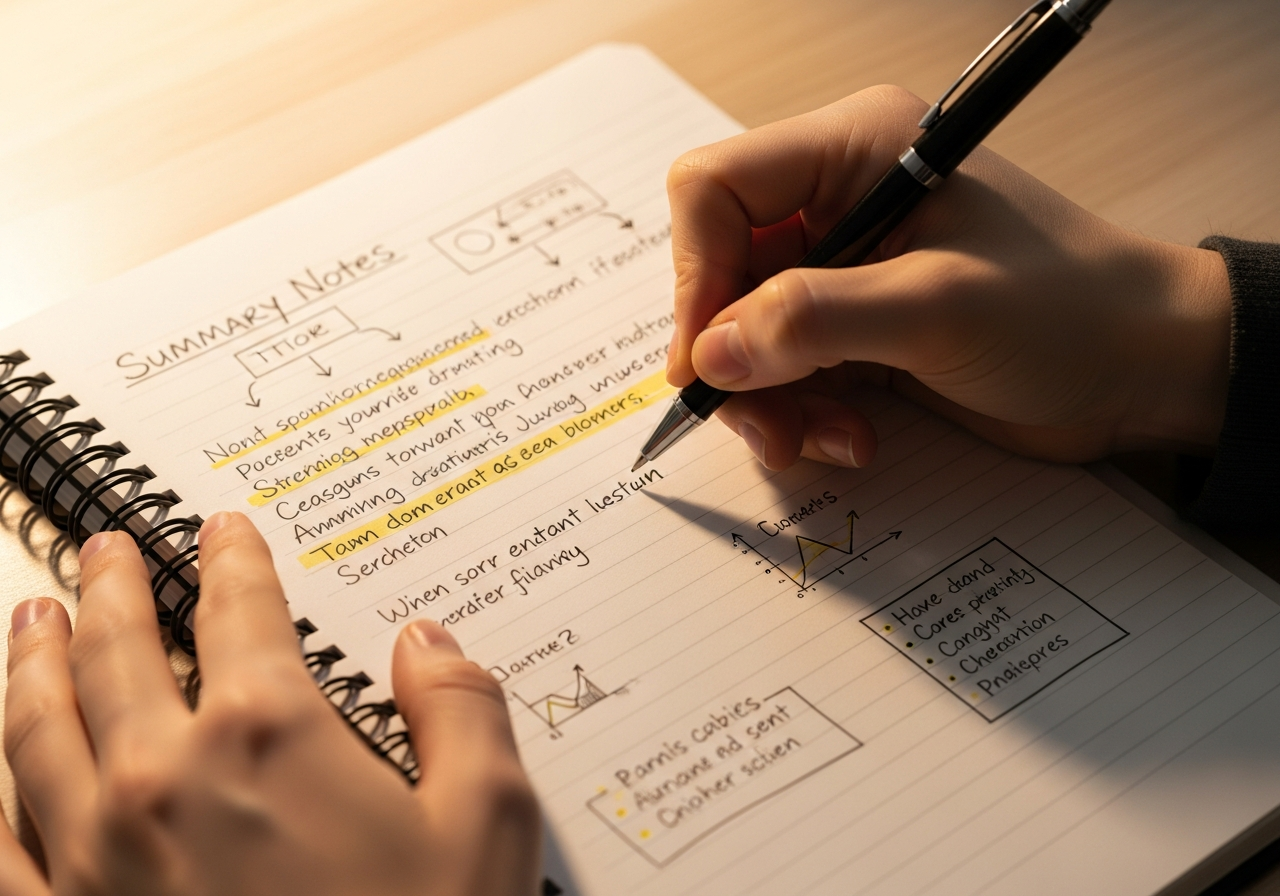
- Summarize in your own words: After reading a chapter, close the book and try to write a summary of what you just read. If you can't, you haven't understood it well.
- Explain it out loud: Imagine you're explaining the topic to a friend who knows nothing about it. This forces you to simplify and structure the ideas.
- Ask yourself questions: Instead of just reading, ask yourself: Why is this important? How does it connect to what I already know?
- Test yourself constantly: This is the ultimate active study technique. Taking tests or using flashcards forces you to retrieve information from your memory (active recall), which is the process that most strengthens learning.
4. Rest Isn't Optional, It's Mandatory
Sometimes we think being productive means never stopping. Big mistake. Your brain is like a muscle: it needs rest to recover and grow.
Sleep is crucial. It's during the night that your brain consolidates what you've learned during the day, transferring information from short-term to long-term memory. Pulling an all-nighter before an exam is one of the worst ideas you can have. It's much more effective to get a good night's sleep.
Besides sleep, short breaks during the day (like the ones in the Pomodoro technique) prevent mental burnout and allow you to get back to it with a fresh mind.

5. Have a Plan: What Do You Want to Accomplish Today?
Sitting down to study with a vague "I'm going to study history" is a recipe for disaster. It's too ambiguous, and it's easy to get lost.
Before starting each session, take two minutes to define a clear and realistic goal.
- Bad goal: "Study for the Biology exam."
- Good goal: "Summarize Topic 3 and take a self-assessment test on it."
Having a concrete goal gives you a clear direction. Plus, the satisfaction of crossing that task off your list when you're done will give you a shot of motivation for the next session.
Quick Recap
If you want to improve your concentration and efficiency, you don't need any magic formulas. Just smart strategies. Remember this:
- Prep your environment: A tidy place with no distractions (goodbye, phone!).
- Use the Pomodoro Technique: Work in 25-minute blocks with 5-minute breaks.
- Practice active studying: Don't just read. Summarize, explain, and above all, test yourself.
- Respect your breaks: Getting enough sleep is non-negotiable. Rest is part of studying.
- Set clear goals: Know what you want to accomplish in each study session.
Turn Your Notes into Your Best Study Tool
Active studying is the key to truly learning, and testing yourself is the most powerful way to do it. Smartests.app is designed for just that: automating the tedious part so you can focus on what's important. Upload your notes, and we'll create tests for you to practice with limitlessly.