
The Ultimate Guide to Passing Multiple-Choice Exams (Without Losing Your Sanity)

Ah, multiple-choice exams. That love-hate relationship for any student. On one hand, you think, "Great, the answer is right there!" On the other, you're faced with four almost identical options designed to make you doubt your own name.
If you've ever walked out of an exam like this feeling like you've been tricked, you're not alone. The good news is that they aren't harder, just... different. They require a different study strategy than an essay exam.
Ready to find out how to master them? Keep reading, because we're about to share the keys to stop dreading them and start acing them.
First Things First: Why Do Multiple-Choice Exams Exist?
Before we dive in, it's helpful to understand why your professors use them. It's not to annoy you (or not just for that reason). Multiple-choice exams have several advantages from an academic standpoint:
- They're objective: An answer is either right or wrong, with no room for subjective interpretation by the grader.
- They allow for broad topic coverage: In a short amount of time, questions can be asked about many different topics, which is impossible in an exam with just a few essay questions.
- They're efficient: Grading 50 multiple-choice exams is much faster than grading 50 essay exams, especially in large classes.
Understanding this helps you shift your mindset: the goal of the exam isn't just for you to remember facts, but to demonstrate a broad and precise understanding of the material. And that's the key to studying for them effectively.
Key Strategies for Studying for a Multiple-Choice Exam
Okay, now for what really matters. How do you prepare to avoid the traps and confidently choose the right option?
1. Don't Just Memorize: Truly Understand
This is the number one mistake: believing that just reading and memorizing is enough. Modern multiple-choice exams don't usually ask, "What is the definition of X?" Instead, they present a practical case and ask you which concept applies.
To avoid this, don't study passively. As you read your notes, ask yourself questions:
- How does this relate to what we covered in the previous topic?
- What's the main difference between this concept and that other very similar one?
- Could I give an example in my own words?
Studying for comprehension is the foundation. The details are important, but they only make sense if you understand the overall framework of the material.

2. Focus on Details and Differences
Once you have the big picture, it's time to drill down into the details. Test questions often focus on the small differences that distinguish one concept from another.
Think about those terms that seem like synonyms but aren't, key dates, the steps in a process, or exceptions to a rule. Those are the weak spots that trick questions will target.
Highlight keywords like "always," "never," "mainly," "except." Pay special attention to lists and classifications. That's where the gold (and the exam questions) is hidden.
And how can you practice this attention to detail effectively without going crazy? This is where technology lends a hand. Smartests.app takes your notes and turns them into multiple-choice exams in seconds. It's the perfect way to test if you really know those small details that make the difference between passing and getting a top grade.
3. Active Practice is Your Best Ally
Do you know the most effective way to study, according to science? Retrieval practice (or active recall). Instead of putting information into your brain (reading), it's about pulling it out (remembering). And there's no better way to do that for a multiple-choice exam than... well, by taking tests.
Taking practice tests helps you:
- Get familiar with the format: You get used to the type of questions and how they're worded.
- Identify your weak spots: You'll instantly see which topics you're struggling with and need to review.
- Improve your speed: You'll learn to manage your time so you don't get stuck.
- Train your memory: Every time you answer a question, you strengthen that neural connection in your brain.
Don't wait until the last day. Take short tests throughout your study process. It's much more effective than a final cram session.
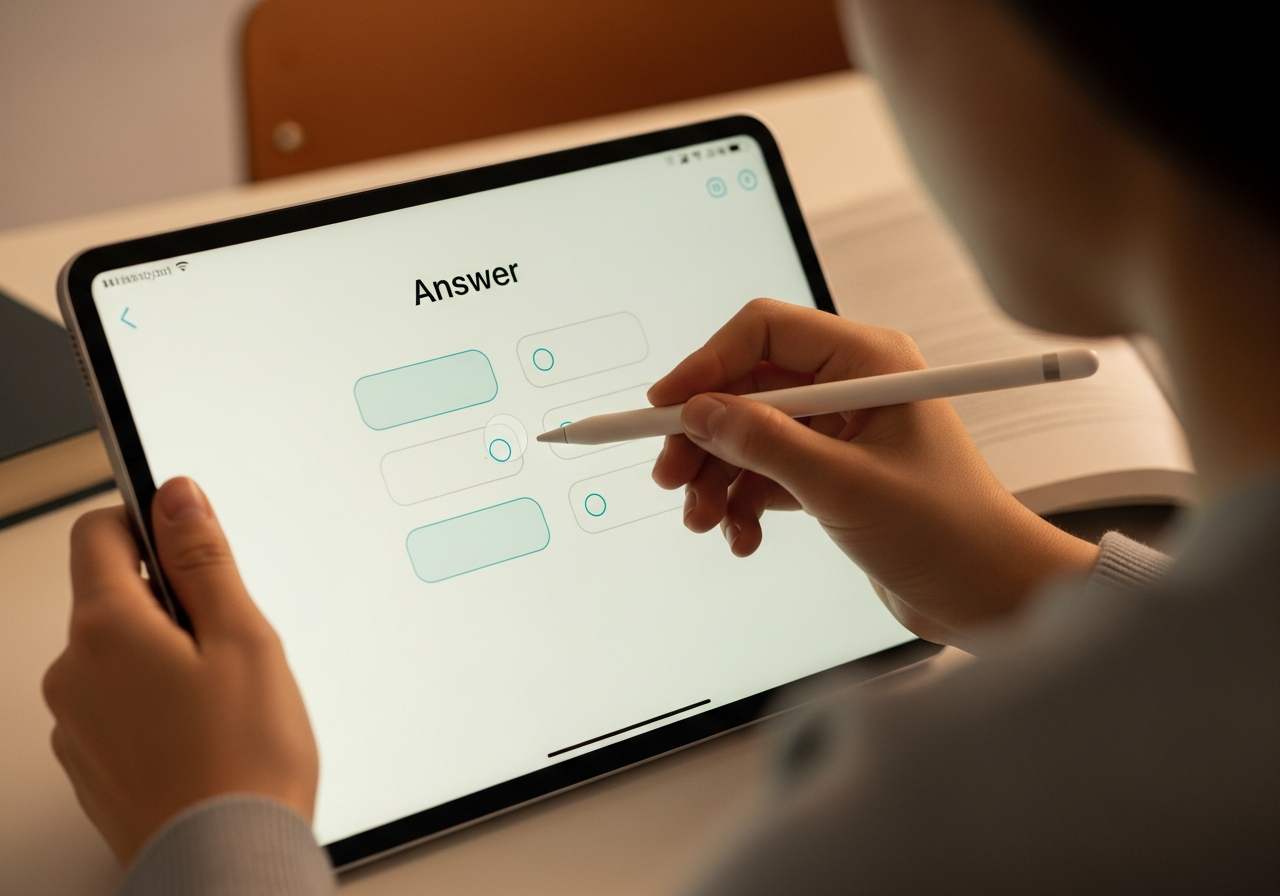
4. Learn to Eliminate (and Manage Your Time)
Studying is half the battle. The other half is knowing how to take the exam. When you face a question, don't look for the right answer directly. First, read all the options and start eliminating the ones you know are incorrect.
Often, out of four options, two are clearly absurd. This leaves you with a choice between two, increasing your odds from 25% to 50%.
And, of course, time. If you get stuck on a question, don't spend five minutes on it. Mark it, skip it, and come back later. It's better to secure 20 easy questions than to obsess over a difficult one and leave 10 unanswered.
Quick Summary
If you only remember one thing, let it be this. To master multiple-choice exams:
- Understand, don't memorize: Focus on understanding the main ideas and how they connect.
- Pay attention to detail: Notice the subtle differences between similar concepts—they're prime material for questions.
- Practice relentlessly: The best way to study for a test is by taking tests. Use tools that make your life easier.
- Master the technique: Learn to eliminate incorrect options and manage your time well during the exam.
Stop Studying More, Start Studying Smarter
Preparing for a multiple-choice exam doesn't have to be torture. With the right strategy and the right tools, you can turn it into just another way to show everything you know.
Smartests was created for exactly that: to help you practice intelligently by turning your own notes into the ultimate study tool. Why not give it a try and see the difference?