
Want to Think Like a Doctor? These 3 Clinical Case Websites Will Help

You know what I'm talking about. You spend hours and hours memorizing classifications, metabolic pathways, and the side effects of drugs you can't even pronounce. You have the theory down, but when you face a real case, things change. Suddenly, there's no chapter title to give you a hint. You just have symptoms, signs, and a patient waiting for answers.
This is where passive studying falls short. To learn how to diagnose, reading isn't enough: you have to think, question, and decide. You need to train your clinical reasoning, and there's nothing like tackling clinical cases for that.
But not all clinical cases are created equal. Many just present you with a paragraph and give you the solution at the end. That doesn't help you build the mental process. What really makes a difference are interactive platforms that force you to go step by step, just like in real life. Today, I'm bringing you the best ones.
Why Not Just Any Clinical Case Will Do
Before we jump into the recommendations, a quick thought. What are you looking for in a good interactive clinical case? You're not looking for a memory test; you're looking for a gym for your medical brain.
The goal is for the platform to present information sequentially:
- Patient history: What does the patient tell you?
- Physical exam: What do you find?
- Initial tests: What do you order first and why?
- Differential diagnosis: What options are you considering?
- Confirmatory tests: How do you rule out or confirm your suspicions?
A resource that gives you all the information at once is robbing you of the chance to think. What we want is to simulate that internal conversation a doctor has: "If they have this symptom, it could be A, B, or C. I'll ask about this other thing to rule out A." That's gamifying the diagnosis.
The 3 Best Websites to Train Your Clinical Eye
We've selected three top resources, each with a different approach, so you can train your diagnostic mind from different angles.
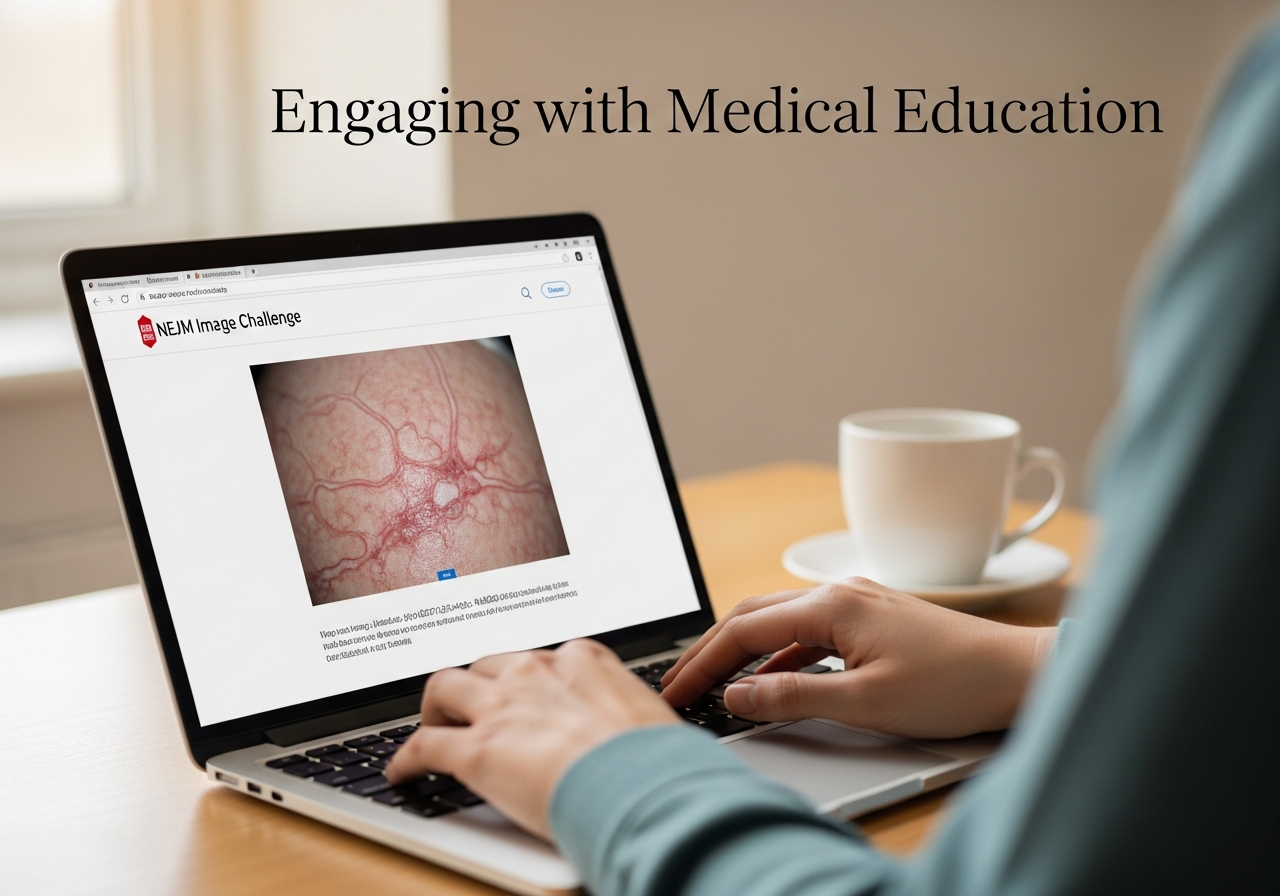
1. NEJM Image Challenge: The Weekly Visual Challenge
The New England Journal of Medicine is one of the bibles of medicine, and its Image Challenge section is a gem.
Every week, they publish a clinical image (an X-ray, a skin lesion, a blood smear...) and ask you a direct question: "What's the diagnosis?". It's a fantastic exercise for training visual pattern recognition, a key skill in specialties like dermatology, radiology, or pathology.
- The best part: It's fast, addictive, and of unquestionable quality. It forces you to pay attention to the details and connect an image with a specific pathology.
- Keep in mind: It doesn't simulate a complete clinical case (history, exam...). It's more of a visual recognition test, but a very high-level one. Ideal for doing in 5 minutes while you have a coffee.
2. Figure 1: The "Instagram" of Medicine
Imagine a social network where thousands of doctors and students from all over the world share real clinical cases (always anonymized, of course). That's Figure 1.
Here, you don't just see the case; you participate in the discussion. A doctor might upload a photo of a strange EKG with the question: "What do you all think?". And below, cardiologists, internists, and students chip in with their two cents. You learn from the case and, above all, from the reasoning process of other professionals. You see how they think, what questions they have, and how they reach a conclusion.
- The best part: The variety is endless, and the cases are 100% real. It's a direct window into daily clinical practice in hospitals around the world.
- Keep in mind: The quality and presentation vary. They don't always follow a didactic structure, but their value for developing a clinical 'gut feeling' is enormous.
Seeing hundreds of cases is great, but how do you make sure the important stuff from your topics sticks? The key is to test your memory actively. With Smartests.app, you can upload your notes on a pathology, and the app will generate a multiple-choice quiz in seconds for you to review the key points.
It's the perfect way to consolidate what you learn on these platforms and make sure you don't forget it.
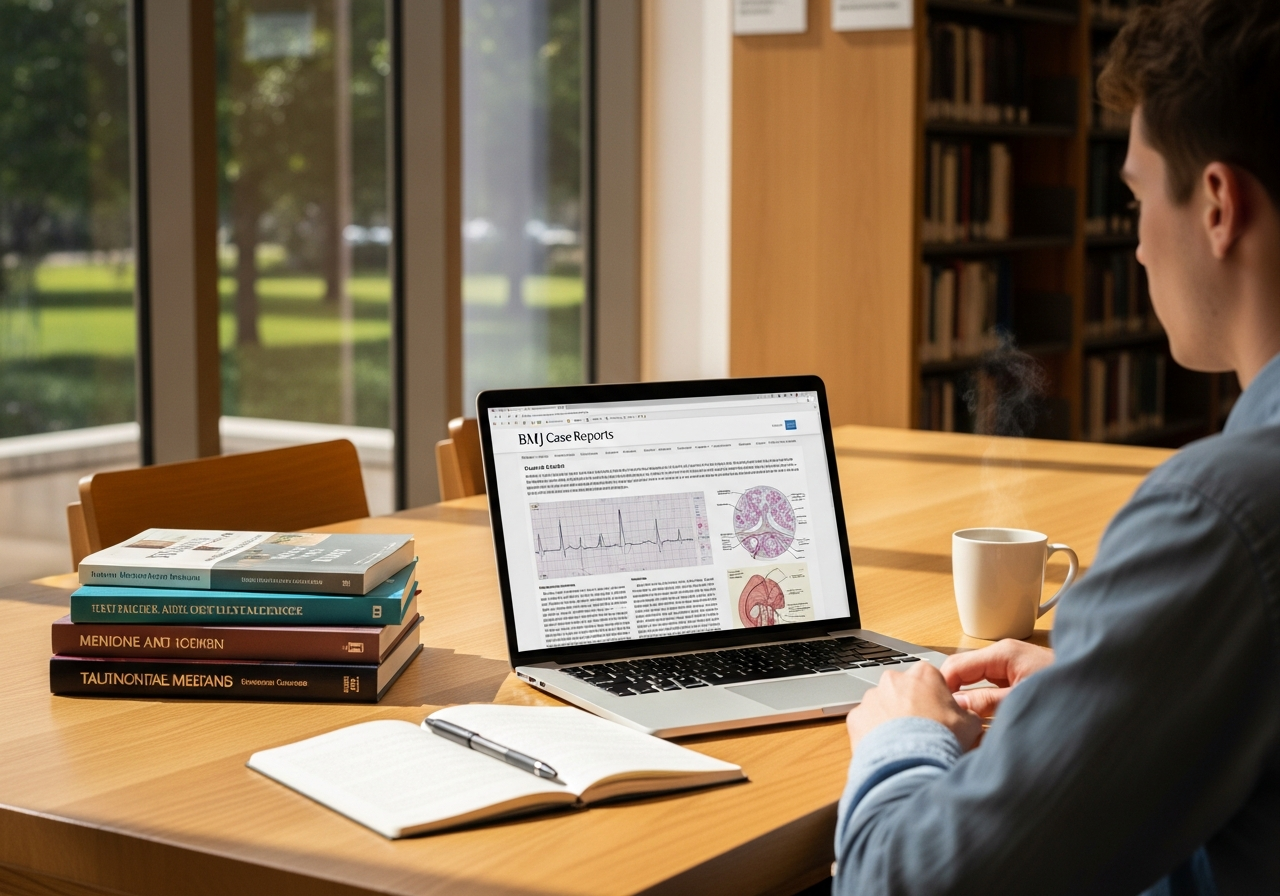
3. BMJ Case Reports: Deep and Structured Learning
If you're looking for rigor and depth, BMJ Case Reports is the place for you. It's one of the largest collections of case reports in the world, all peer-reviewed.
Although it might seem more 'academic,' many of its cases are presented in an incredibly didactic way. They describe the patient's history, physical exam, investigations, and outcome step by step. At the end of each case, they usually include a section of "learning points", which are pure gold.
- The best part: The quality and reliability are top-notch. Ideal for when you want to understand a rare disease or an atypical presentation of a common one.
- Keep in mind: You'll need an institutional subscription (most universities have one). It's not as much of a 'game' as the others, but it's unbeatable for in-depth learning.
Quick Summary: Your Diagnostic Training Kit
To make it crystal clear, here's a summary of your new arsenal for diagnostic training:
- NEJM Image Challenge: Use it for a quick, weekly visual challenge. Perfect for sharpening your clinical eye.
- Figure 1: Dive in here to see real medicine, join discussions, and learn from the reasoning of other doctors.
- BMJ Case Reports: Turn to this source for a deep, structured, and reliable analysis of complex or rare cases.
Turn Every Case into a Quiz So You Don't Forget
Learning to diagnose is a marathon, not a sprint. The key is constant practice. Integrate these tools into your routine, and you'll see how your way of thinking evolves. You'll go from memorizing data to connecting clues.
And remember, after studying a topic or analyzing an interesting clinical case, the best way to make that information stick is to test yourself.
Smartests.app helps you with just that. Take your notes, upload them, and instantly create a multiple-choice quiz to reinforce what you've learned. Less effort, more retention.