
Microbiology Quiz: Key Questions on Gram-Positive vs. Negative Bacteria
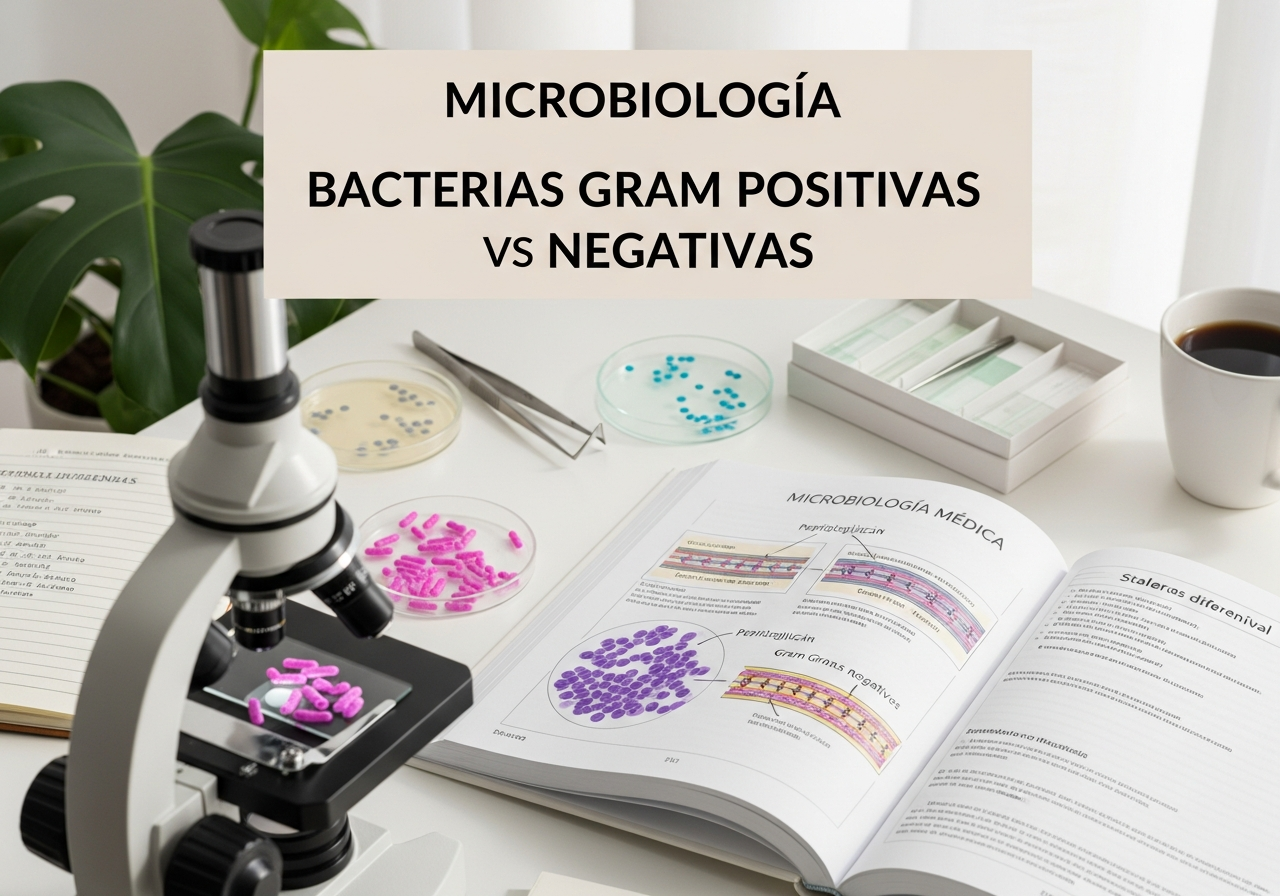
Hey, future doctor! We know the distinction between Gram-positive and Gram-negative bacteria is one of those pillars of Microbiology that, if you don't have it down, can complicate not just your exam, but your entire career. The difference goes way beyond a simple color under the microscope; it defines pathogenesis, immune response, and, crucially, the choice of antibiotic. The best way to master it isn't by reading over and over, but by testing yourself. Active Recall is your best friend. Shall we start?
Test Yourself: Gram-Positive vs. Negative Bacteria Quiz
-
What is the main structural difference in the cell wall that explains the retention of crystal violet in Gram-positive bacteria? a) The presence of an outer membrane rich in lipopolysaccharides (LPS). b) A much thicker, multi-cross-linked peptidoglycan layer. c) The presence of porins that prevent the dye from exiting. d) The absence of teichoic acids in their wall.
-
Endotoxin, responsible for many of the systemic signs of septic shock, is a component exclusive to: a) The cell wall of Gram-positive bacteria. b) The spores of bacteria like Clostridium. c) The capsule of both Gram-positive and Gram-negative bacteria. d) The outer membrane of Gram-negative bacteria.
-
A patient presents with fulminant septic shock. Their blood analysis reveals a massive presence of Lipid A. What type of bacterium is the most likely etiological agent? a) A staphylococcus (Gram-positive). b) A streptococcus (Gram-positive). c) A neisseria (Gram-negative). d) A clostridium (Gram-positive, spore-forming).
-
Teichoic and lipoteichoic acids are characteristic polymers found anchored in: a) The outer membrane of Gram-negative bacteria, acting as O antigens. b) The peptidoglycan wall of Gram-positive bacteria, contributing to virulence. c) The periplasmic space of Gram-negative bacteria, aiding in nutrient transport. d) The cytoplasmic membrane of all bacteria.
-
Why are Gram-negative bacteria intrinsically more resistant to certain antibiotics like penicillin G or vancomycin compared to Gram-positive bacteria? a) Because they universally produce beta-lactamases. b) Because their thick peptidoglycan layer prevents the drug from reaching its target. c) Because their outer membrane acts as a selective permeability barrier. d) Because they lack PBPs (Penicillin-Binding Proteins).
-
During the Gram stain procedure, which step is the fundamental differentiator between the two types of bacteria? a) The application of the primary stain (crystal violet). b) The addition of the mordant (iodine). c) The decolorization with alcohol-acetone. d) The application of the counterstain (safranin).
-
The ability to form resistant endospores is a characteristic of certain bacterial genera, which are mostly: a) Gram-positive, like Bacillus and Clostridium. b) Gram-negative, like Escherichia and Pseudomonas. c) Mycobacteria, due to their mycolic acid-rich wall. d) Spirochetes, like Treponema pallidum.
-
The periplasmic space, a metabolically active area containing hydrolytic enzymes and transport proteins, is a prominent feature of: a) Gram-positive bacteria. b) Gram-negative bacteria. c) Mycoplasmas, which lack a cell wall. d) All bacteria with a cell wall.
-
Exotoxins, potent secreted proteins that cause damage at a distance in the host, are produced by: a) Mainly Gram-positive bacteria, although some Gram-negative bacteria also produce them. b) Exclusively Gram-negative bacteria as part of their LPS. c) Only bacteria capable of forming spores. d) Only intracellular bacteria.
-
Braun's Lipoprotein is an important molecule in Gram-negative bacteria because it: a) Forms the porin channels in the outer membrane. b) Anchors the outer membrane to the underlying peptidoglycan layer. c) Is the main toxic component of lipopolysaccharide (LPS). d) Acts as a receptor for many bacteriophages.
How did it go? The reasoned solutions are below. If you missed more than 3, you need to review your notes. This is a topic you can't afford to be unsure about on your Microbiology exam.
Answers and Explanations
-
Correct answer: b) A much thicker, multi-cross-linked peptidoglycan layer.
- Explanation: Gram-positive bacteria have a peptidoglycan wall that can be up to 40 layers thick. During staining, the crystal violet-iodine complex gets trapped in this dense network, resisting decolorization with alcohol. Gram-negative bacteria have a very thin layer (1-2 layers) that doesn't retain the dye.
-
Correct answer: d) The outer membrane of Gram-negative bacteria.
- Explanation: Endotoxin is, by definition, Lipopolysaccharide (LPS), an integral structural component of the outer membrane of Gram-negative bacteria. It's not something the bacterium actively secretes, but rather is released en masse when the bacterium lyses.
-
Correct answer: c) A neisseria (Gram-negative).
- Explanation: Lipid A is the toxic portion of LPS (endotoxin). Such a severe clinical picture, mediated by endotoxins, is characteristic of sepsis caused by Gram-negative bacteria. Neisseria meningitidis is a classic example of a Gram-negative bacterium that causes fulminant sepsis.
-
Correct answer: b) The peptidoglycan wall of Gram-positive bacteria, contributing to virulence.
- Explanation: Teichoic acids (linked to peptidoglycan) and lipoteichoic acids (linked to the cytoplasmic membrane) are exclusive to Gram-positive bacteria. They are important for structural integrity, adhesion to host cells, and are potent inducers of the inflammatory response.
-
Correct answer: c) Because their outer membrane acts as a selective permeability barrier.
- Explanation: The outer membrane of Gram-negative bacteria prevents many large or hydrophilic antibiotics (like vancomycin) from reaching their target in the peptidoglycan or cytoplasm. This is a fundamental physical barrier that Gram-positive bacteria do not have.
-
Correct answer: c) The decolorization with alcohol-acetone.
- Explanation: This is the critical step. The decolorizer dehydrates the thick wall of Gram-positive bacteria, closing the pores and trapping the dye. In Gram-negative bacteria, the alcohol dissolves the outer membrane and passes through the thin peptidoglycan layer, washing out the dye.
-
Correct answer: a) Gram-positive, like Bacillus and Clostridium.
- Explanation: Endospore formation is an extreme survival mechanism that, from a medical standpoint, is associated almost exclusively with clinically important Gram-positive bacterial genera like Bacillus (causes anthrax) and Clostridium (causes tetanus, botulism, gas gangrene).
-
Correct answer: b) Gram-negative bacteria.
- Explanation: The periplasmic space is the compartment located between the cytoplasmic membrane and the outer membrane in Gram-negative bacteria. It is an area of high enzymatic activity. In Gram-positive bacteria, this space is virtual or nonexistent.
-
Correct answer: a) Mainly Gram-positive bacteria, although some Gram-negative bacteria also produce them.
- Explanation: Although it's a generalization, the "classic" and most potent toxins (tetanus toxin, diphtheria toxin, erythrogenic toxin) are exotoxins produced by Gram-positive bacteria. However, Gram-negative bacteria like E. coli or Vibrio cholerae also produce very important exotoxins (Shiga toxin, Cholera toxin).
-
Correct answer: b) Anchors the outer membrane to the underlying peptidoglycan layer.
- Explanation: The structure of the Gram-negative wall needs stability. Braun's lipoprotein is one of the most abundant proteins, and its function is to act like a "screw" that covalently links the outer membrane to the thin peptidoglycan layer, maintaining the integrity of the entire cell envelope.

Where Students Usually Go Wrong with Gram-Positive vs. Negative Bacteria
- Confusing Endotoxin vs. Exotoxin: The classic mistake is not being clear that endotoxin (LPS) is STRUCTURAL and exclusive to Gram-negatives, while exotoxins are SECRETED PROTEINS, produced by both groups (though more famous in Gram-positives).
- Oversimplifying Antibiotic Resistance: Thinking that Gram-negative resistance is only due to beta-lactamases. The OUTER MEMBRANE barrier is an equally or more important intrinsic resistance factor for many drugs.
- Forgetting the "Exceptions": Not everything on the exam is E. coli or S. aureus. They'll ask you about bacteria that don't Gram stain, like Mycobacteria (due to their mycolic acid wall, they are stained with Ziehl-Neelsen) or Mycoplasma (which lacks a cell wall). Knowing why they don't fit the classification shows a superior command of the topic.
Is Your Exam Different?
This practice test covers the universal microbiology concepts that every medical student must master. These are the questions you'd find in a reference textbook like Murray or Jawetz.
The problem is, your exam wasn't designed by a textbook, but by your professor. And your professor has their favorite slides, their recurring trick questions, and focuses on nuances they've only explained in class. That's where generic internet quizzes fall short.
The only way to prepare for the real questions on your exam is by studying with your own material. Upload your PDF or your notes on the "Gram-Positive vs. Negative Bacteria" topic to Smartests and let our AI analyze YOUR syllabus and generate a custom quiz, with the same focus and terminology your professor will use.
Quick Summary
- Structure is destiny: The key difference (thick peptidoglycan in G+ vs. thin peptidoglycan + outer membrane in G-) determines the stain, pathogenesis, and response to antibiotics.
- Toxins define the clinical picture: Endotoxins (LPS) are exclusive to Gram-negatives and are the cause of septic shock. Exotoxins are secreted, very potent proteins, and are characteristic of many Gram-positives.
- The Gram stain is the first step: It's the most important and rapid diagnostic decision in bacteriology, guiding the initial empirical antibiotic treatment that can save a patient's life.