
Practice Exam: Have You Mastered Acute and Chronic Inflammation? | General Pathology 3rd Year Med School
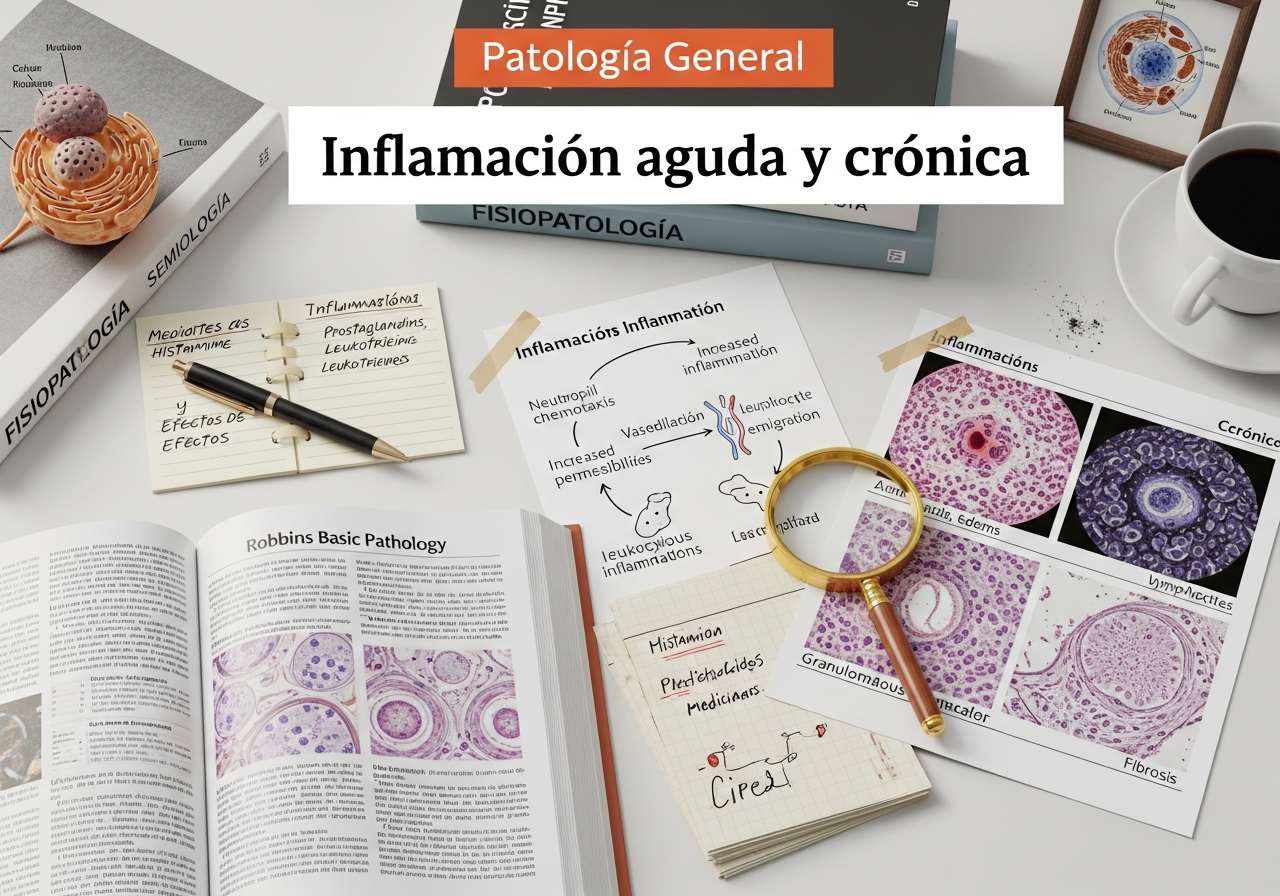
We know you're in your 3rd year of med school and that General Pathology is one of the densest subjects. Specifically, the topic of Acute and Chronic Inflammation is a cornerstone, packed with mediators, cells, and processes that can be a real maze. Remembering what each interleukin does or the difference between transudate and exudate on an exam can be stressful. The best way to lock in these concepts isn't to read them over and over, but to test your knowledge. This practice test is designed for just that: to help you practice using the Active Recall method.
Test Yourself: Acute and Chronic Inflammation Quiz
1. During the acute inflammatory response, the first vascular event that occurs after a brief initial vasoconstriction is: a) Increased vascular permeability. b) Leukocyte margination and rolling. c) Arteriolar vasodilation. d) Formation of a fibrin-rich exudate.
2. Which of the following molecules is primarily responsible for the firm adhesion of leukocytes to the endothelium during extravasation? a) P-selectin. b) E-selectin. c) Integrins. d) Histamine.
3. A patient presents with a skin abscess. Histologically, what type of cellular infiltrate would you predominantly expect to find? a) Lymphocytes and plasma cells. b) Macrophages and epithelioid cells. c) Neutrophils. d) Eosinophils.
4. Which mediator of inflammation is responsible for vasodilation, pain, and fever? a) Leukotriene B4. b) Prostaglandin E2 (PGE2). c) Complement C5a. d) Tumor Necrosis Factor (TNF).
5. Granulomatous inflammation is a characteristic pattern of chronic inflammation. Which of the following is its key defining cell? a) The CD8+ T lymphocyte. b) The antibody-producing plasma cell. c) The activated macrophage with epithelioid morphology. d) The polymorphonuclear neutrophil.
6. Which of the following is a systemic change associated with acute inflammation (acute-phase response)? a) Decrease in C-Reactive Protein (CRP). b) Leukopenia (decrease in leukocytes). c) Increased hepatic synthesis of fibrinogen. d) Hypothermia.
7. In chronic inflammation, the alternative pathway of macrophage activation (induced by IL-4 and IL-13) is primarily associated with: a) Microbial destruction and pro-inflammatory inflammation. b) Tissue repair and fibrosis. c) Antigen presentation to B lymphocytes. d) The formation of caseating granulomas.
8. The main difference between a transudate and an exudate is: a) The transudate has a high concentration of proteins and cells. b) The exudate is due to an increase in hydrostatic pressure. c) The exudate has a high specific gravity (>1.020) and is rich in protein. d) The transudate is characteristic of acute inflammation.
9. Which cytokines are considered the main mediators of acute inflammation, responsible for inducing the acute-phase response and the expression of endothelial adhesion molecules? a) IL-4 and IL-10. b) Interferon-gamma (IFN-γ) and TGF-β. c) TNF and IL-1. d) IL-17 and IL-22.
10. Complete resolution is one of the possible outcomes of acute inflammation. What condition is ESSENTIAL for this to occur? a) The injurious agent being a pyogenic bacterium. b) The presence of extensive tissue necrosis. c) The injured tissue having the capacity for regeneration. d) The inflammation progressing to a chronic state.
How did it go? The detailed answers are below. If you got more than 3 wrong, it's a clear sign that you need to review your notes and, most importantly, practice more with your professor's specific material. Let's get to it!
Answers and Explanations
-
Correct Answer: c) Arteriolar vasodilation.
- Explanation: After a transient vasoconstriction (seconds), histamine and nitric oxide (NO) induce the vasodilation of arterioles. This increases local blood flow (causing redness and heat) and precedes the increase in permeability of postcapillary venules.
-
Correct Answer: c) Integrins.
- Explanation: Leukocyte extravasation is a sequence. First, selectins mediate the initial, loose rolling and adhesion. Then, chemokines activate the leukocytes, causing a conformational change in their integrins, which switch to a high-affinity state. These integrins bind firmly to their ligands on the endothelium (like ICAM-1), stopping the leukocyte before diapedesis.
-
Correct Answer: c) Neutrophils.
- Explanation: An abscess is a localized collection of pus, which is a purulent exudate. This type of inflammation is primarily composed of neutrophils, both viable and necrotic, and cellular debris. It is the characteristic response to pyogenic bacterial infections.
-
Correct Answer: b) Prostaglandin E2 (PGE2).
- Explanation: Prostaglandins, synthesized via the cyclooxygenase (COX) pathway, are key mediators. Specifically, PGE2 is a potent vasodilator, sensitizes nerve endings to pain (along with bradykinin), and acts on the hypothalamus to induce fever.
-
Correct Answer: c) The activated macrophage with epithelioid morphology.
- Explanation: The hallmark of a granuloma is the accumulation of activated macrophages that take on an appearance similar to epithelial cells (epithelioid cells). They often fuse to form multinucleated giant cells. They are surrounded by a collar of T lymphocytes.
-
Correct Answer: c) Increased hepatic synthesis of fibrinogen.
- Explanation: The acute-phase response, mediated by cytokines like IL-1, IL-6, and TNF, induces the liver to produce acute-phase proteins. Among them are C-Reactive Protein (CRP) and fibrinogen. The increase in fibrinogen causes red blood cells to stack (rouleaux), which accelerates the erythrocyte sedimentation rate (ESR).
-
Correct Answer: b) Tissue repair and fibrosis.
- Explanation: Macrophages have two main activation pathways. The classical pathway (induced by IFN-γ) is microbicidal and pro-inflammatory. The alternative pathway (induced by IL-4, IL-13) is not as effective against microbes, and its main function is to promote tissue repair, angiogenesis, and collagen synthesis, which can lead to fibrosis.
-
Correct Answer: c) The exudate has a high specific gravity (>1.020) and is rich in protein.
- Explanation: An exudate is the result of the increased vascular permeability typical of inflammation. It allows the escape of fluid, plasma proteins (like fibrin), and cells, making it dense and content-rich. In contrast, a transudate is an ultrafiltrate of plasma with few proteins and cells, caused by hemodynamic imbalances (increased hydrostatic pressure or decreased oncotic pressure), not by inflammation itself.
-
Correct Answer: c) TNF and IL-1.
- Explanation: Tumor Necrosis Factor (TNF) and Interleukin-1 (IL-1) are the "superstars" of acute inflammation. They are produced mainly by activated macrophages and are responsible for most of the local (endothelial activation) and systemic (fever, leukocytosis, production of acute-phase reactants) manifestations of inflammation.
-
Correct Answer: c) The injured tissue having the capacity for regeneration.
- Explanation: Complete resolution involves the elimination of the injurious agent, reabsorption of the exudate, and restoration of normal tissue architecture. This is only possible if the tissue damage was limited and if the parenchymal cells of the affected tissue (e.g., hepatocytes, epithelium) are capable of regenerating and replacing those that were lost. If there is extensive destruction or the tissue does not regenerate (e.g., myocardium), the outcome will be scarring (fibrosis).

Where Students Usually Go Wrong with Acute and Chronic Inflammation
- Confusing the roles of Selectins and Integrins: This is a classic mistake. Remember the sequence: Selectins (E and P) are for the initial, weak "braking and rolling." Integrins are for the "dead stop" or firm adhesion, and they need to be activated by chemokines to work.
- Not differentiating between types of granulomas: Not all granulomas are the same. Professors love to ask about the difference between a caseating granuloma (typical of Tuberculosis, with an amorphous necrotic center) and a non-caseating one (typical of sarcoidosis or Crohn's disease, without central necrosis).
- Forgetting the mediators of pain: While many remember histamine for vasodilation and permeability, they often forget the specific mediators of pain. Prostaglandins and Bradykinin are the main culprits for sensitizing nerve endings.
Is Your Exam Different?
This quiz is based on the universal principles of General Pathology that you'll find in Robbins or similar textbooks. It's an excellent tool for assessing your overall understanding.
However, your professor has their own favorite topics. There's probably a specific mediator they emphasize, a type of inflammation they explain in more detail, or "trick" questions they repeat every year. Those crucial details that make the difference between passing and getting a great grade aren't on a generic internet quiz. They're in YOUR notes.
That's where Smartests.app gives you the ultimate advantage. Upload your PDF or photos of your notes on Acute and Chronic Inflammation, and our AI will generate a 100% personalized practice exam with questions based exactly on what your professor thinks is important. Stop studying "blind" and start practicing with the material that really counts.
Generate my personalized quiz now
Quick Summary
Today we've reviewed key concepts and you've tested yourself. Remember these three points:
- Acute Inflammation: A rapid response dominated by neutrophils and vascular changes (vasodilation and increased permeability) mediated by histamine, TNF, and IL-1.
- Chronic Inflammation: A prolonged response with an infiltrate of macrophages and lymphocytes, associated with tissue destruction and attempts at repair (fibrosis). The granuloma is its most specialized morphological pattern.
- Practice makes perfect: Mastering this topic requires not only understanding the theory but also actively practicing with questions that reflect what you'll be asked. And for that, there's nothing better than a quiz based on your own syllabus.