
Pulmonology Exam: Master the Key Differences Between COPD and Asthma
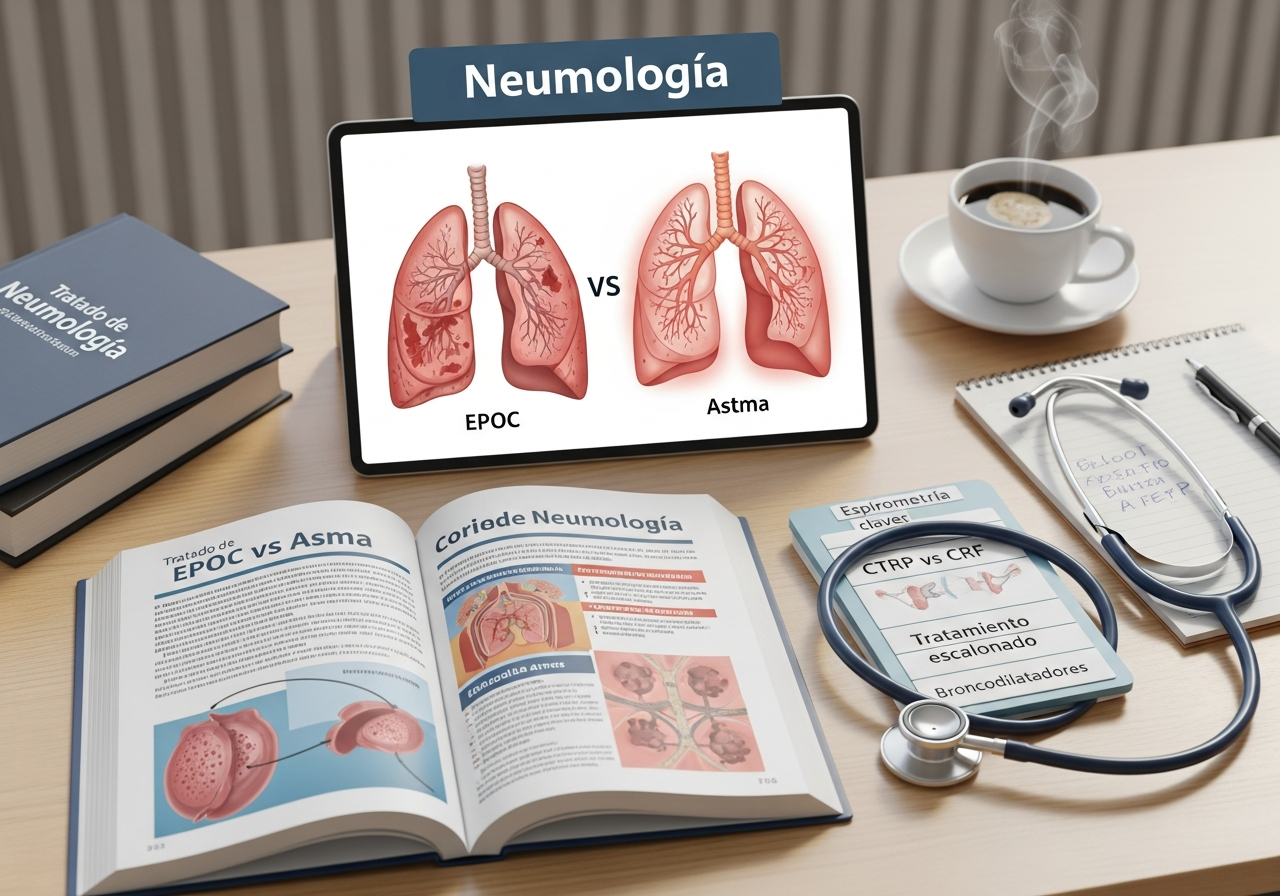
Hey, future doctor. We know that differentiating between COPD and asthma is one of the classic puzzles in your 4th-year pulmonology course. The symptoms overlap, spirometry can be confusing, and the clinical nuances are crucial. The best way to solidify these concepts isn't just reading over and over, but to test yourself. Active recall is your best ally for identifying gaps and cementing your knowledge. This practice test is designed to help you tackle the most common points of confusion. Let's get to it!
Test Yourself: COPD vs. Asthma Quiz
-
What is the main histopathological feature that distinguishes the inflammation in COPD from that in asthma? a) Predominance of Th17 lymphocytes in asthma and Th2 in COPD. b) Predominance of eosinophils and mast cells in asthma; neutrophils and macrophages in COPD. c) Subepithelial fibrosis is exclusive to COPD. d) Submucosal gland hypertrophy is more pronounced in asthma.
-
A 65-year-old patient, a 40 pack-year smoker, has a spirometry test showing an FEV1/FVC ratio of 0.65. After administering a bronchodilator, their FEV1 improves by 8% and 150 ml. What is the most likely interpretation? a) Late-onset asthma with fixed obstruction. b) Completely reversible bronchial obstruction, consistent with asthma. c) Non-reversible obstructive pattern, highly suggestive of COPD. d) Restrictive pattern secondary to smoking.
-
Regarding the diffusing capacity of the lungs for carbon monoxide (DLCO), what pattern would you typically expect to find in a patient with uncontrolled asthma versus one with emphysematous COPD? a) Decreased DLCO in both cases. b) Normal or increased DLCO in asthma; decreased in COPD. c) Decreased DLCO in asthma; normal in COPD. d) Normal DLCO in both, as it primarily affects the airways.
-
A 25-year-old non-smoking woman reports episodes of coughing and wheezing, especially at night and after exercise. Her father has allergic rhinitis. Which clinical finding is MORE suggestive of asthma than COPD? a) The presence of wheezing. b) Chronic cough. c) The variability of symptoms and specific triggers (night, exercise). d) Dyspnea on exertion.
-
Regarding baseline pharmacological treatment, which of the following statements is most correct? a) Inhaled corticosteroids (ICS) are the first-line treatment for all patients with COPD. b) Long-acting bronchodilators (LABA/LAMA) are the cornerstone of COPD treatment, while ICS are the cornerstone for persistent asthma. c) Leukotriene modifiers are equally effective in asthma and COPD. d) LAMAs (long-acting muscarinic antagonists) are not useful in the treatment of asthma.
-
On a chest X-ray of a patient with advanced COPD, it is characteristic to find: a) A diffuse interstitial pattern. b) Patchy alveolar infiltrates. c) Signs of hyperinflation, such as diaphragmatic flattening and increased retrosternal space. d) Recurrent lobar atelectasis.
-
Which comorbidity is most strongly associated with COPD due to shared systemic inflammatory mechanisms? a) Crohn's disease. b) Cardiovascular disease (ischemic heart disease, heart failure). c) Rheumatoid arthritis. d) Hypothyroidism.
-
A patient presents with features of both asthma and COPD (smoker, sputum eosinophilia, partial but significant reversibility). This phenotype is known as ACOS (Asthma-COPD Overlap Syndrome). What is expected regarding their prognosis and treatment? a) Better prognosis than "pure" COPD and excellent response to bronchodilators alone. b) Worse prognosis, with more frequent exacerbations and a good response to the ICS/LABA combination. c) A clinical course identical to allergic asthma. d) A lower risk of developing cor pulmonale.
-
Which of the following parameters is most useful for differentiating an asthma exacerbation from a COPD exacerbation in the emergency department? a) The C-reactive protein (CRP) level. b) The presence of hypoxemia on arterial blood gas analysis. c) The patient's personal history (age of onset, smoking history, atopy). d) The finding of crackles on pulmonary auscultation.
-
Total serum IgE is typically elevated in a specific phenotype of: a) Chronic bronchitis-type COPD. b) Allergic asthma. c) COPD associated with alpha-1-antitrypsin deficiency. d) Intrinsic or non-allergic asthma.
How did it go? Below are the answers with explanations. If you missed more than 3, you need to review your notes thoroughly and, most importantly, practice with questions tailored to them.
Answers and Explanations
-
Correct answer: b) Predominance of eosinophils and mast cells in asthma; neutrophils and macrophages in COPD.
- Explanation: This is the fundamental pathophysiological difference. Asthma inflammation is typically mediated by Th2 lymphocytes, resulting in an eosinophil-rich infiltrate. In contrast, COPD is characterized by inflammation mediated by Tc1 and Th1 lymphocytes, with a predominance of neutrophils and macrophages in the airways.
-
Correct answer: c) Non-reversible obstructive pattern, highly suggestive of COPD.
- Explanation: A post-bronchodilator FEV1/FVC ratio < 0.70 confirms a non-reversible obstruction. The criterion for significant reversibility (characteristic of asthma) is an improvement in FEV1 of >12% AND >200 ml from the baseline value. This patient does not meet both criteria, which, along with their smoking history, points directly to COPD.
-
Correct answer: b) Normal or increased DLCO in asthma; decreased in COPD.
- Explanation: DLCO measures the integrity of the alveolar-capillary membrane. In emphysematous COPD, there is destruction of the alveolar septa, which reduces the gas exchange surface area and, therefore, the DLCO. In asthma, the pathology is mainly bronchial and the parenchyma is intact, so the DLCO is usually normal or even increased.
-
Correct answer: c) The variability of symptoms and specific triggers (night, exercise).
- Explanation: Although coughing and wheezing can be present in both, diurnal/nocturnal variability and onset with clear triggers like exercise or allergens is the hallmark of asthma. COPD tends to present with more persistent and progressive symptoms.
-
Correct answer: b) Long-acting bronchodilators (LABA/LAMA) are the cornerstone of COPD treatment, while ICS are the cornerstone for persistent asthma.
- Explanation: In COPD, the initial and fundamental treatment is bronchodilation to relieve symptoms. ICS are reserved for patients with frequent exacerbations and/or eosinophilia. In contrast, for persistent asthma, ICS are the baseline anti-inflammatory treatment to control the disease.
-
Correct answer: c) Signs of hyperinflation, such as diaphragmatic flattening and increased retrosternal space.
- Explanation: Chronic air trapping in COPD leads to hyperinflation of the lungs. Radiologically, this translates to flattened hemidiaphragms, a barrel chest, increased retrosternal air space, and sometimes bullae. The chest X-ray in asthma between attacks is usually normal.
-
Correct answer: b) Cardiovascular disease (ischemic heart disease, heart failure).
- Explanation: COPD is not just a lung disease; it involves a chronic, low-grade systemic inflammatory state. This pro-inflammatory state accelerates atherosclerosis and significantly increases the risk of cardiovascular events, which are one of the main causes of mortality in these patients.
-
Correct answer: b) Worse prognosis, with more frequent exacerbations and a good response to the ICS/LABA combination.
- Explanation: Patients with ACOS tend to have a poorer quality of life and a higher number of exacerbations than those with only asthma or COPD. However, the presence of an "asthmatic" component (like eosinophilia) means they benefit greatly from treatment with inhaled corticosteroids (ICS) along with bronchodilators.
-
Correct answer: c) The patient's personal history (age of onset, smoking history, atopy).
- Explanation: In the acute setting, symptoms and signs can be indistinguishable. The key to guiding the differential diagnosis is the clinical history: a young, atopic, non-smoking patient likely has asthma. A patient over 40 with a heavy smoking history likely has COPD.
-
Correct answer: b) Allergic asthma.
- Explanation: IgE is the central antibody in type I hypersensitivity reactions, which are the basis of allergic asthma. Exposure to an allergen triggers IgE-mediated degranulation of mast cells, causing bronchoconstriction. In COPD, IgE does not play a major pathogenic role.

Where Students Usually Go Wrong with COPD vs. Asthma
- Reversibility isn't 'all or nothing': Many believe that COPD has ZERO reversibility. False. Some COPD patients can show improvement after a bronchodilator, but it doesn't meet the formal criteria for asthma (>12% and 200 ml). Don't rule out COPD just because you see a small improvement.
- Indiscriminate use of Inhaled Corticosteroids (ICS) in COPD: A classic mistake is thinking that if asthma is treated with ICS, COPD should be too. Be careful! In COPD, ICS are only indicated for very select patients (frequent exacerbators, high eosinophil counts) and are associated with a higher risk of pneumonia. The foundation of treatment is bronchodilators.
- Confusing dyspnea with obstruction: A patient can have significant dyspnea (shortness of breath) but mild obstruction on spirometry, and vice versa. Dyspnea in COPD is multifactorial (air trapping, muscle deconditioning, cardiac comorbidities) and doesn't correlate perfectly with FEV1 alone.
Is Your Exam Different?
This quiz covers the universal pulmonology concepts that every student needs to know to differentiate between COPD and Asthma. It's an excellent foundation.
But let's be honest. Your professor has their favorite slides, their questions from previous years, and those 'pearls' that only appear in their material. The questions on your real exam will be based on the notes you took in THEIR class, not on a blog post, no matter how good it is.
That's where this general practice test falls short. To secure a passing grade, you need to practice with what you will be asked. Upload your PDF notes on COPD and Asthma to Smartests and let our AI analyze your syllabus and generate a 100% custom exam. No fluff, no noise, just straight to what your professor thinks is important.
Quick Summary
Today, we've reinforced three key ideas for differentiating between these two conditions:
- Inflammation is key: Eosinophils in asthma vs. Neutrophils in COPD. This determines the response to treatment.
- Spirometry doesn't lie (usually): Significant reversibility (>12% and 200ml) after a bronchodilator is the hallmark of asthma. Fixed, non-reversible obstruction points to COPD.
- Clinical presentation guides the diagnosis: Age of onset, smoking history, and symptom variability are the most important clues before any tests.