
Social Cognition Multiple-Choice Exam: The Ultimate Study Technique (1st Year Psychology)

If you're in your first year of Psychology, you've probably come across "Social Cognition." It's one of those fascinating subjects that blows your mind with ideas about how we think, perceive, and interact with others. Sounds cool, right?
The problem is, when it's time to study, that fascination can turn into a bit of a mess. So many abstract concepts, so many biases with similar-sounding names, so many theoretical models... It's easy to get lost in your notes and end up just memorizing without really understanding.
But don't worry, that's what we're here for. In this post, we're not only going to break down why this subject is a tough nut to crack, but we'll also give you an ultra-effective study technique and, for dessert, a multiple-choice exam to test yourself. Let's get to it!
What is Social Cognition and Why It Can Feel Overwhelming?
In a nutshell, Social Cognition is the study of the mental processes we use to understand the social world. In other words, how our minds process information about other people, ourselves, and social situations.
This is where key concepts come into play, like:
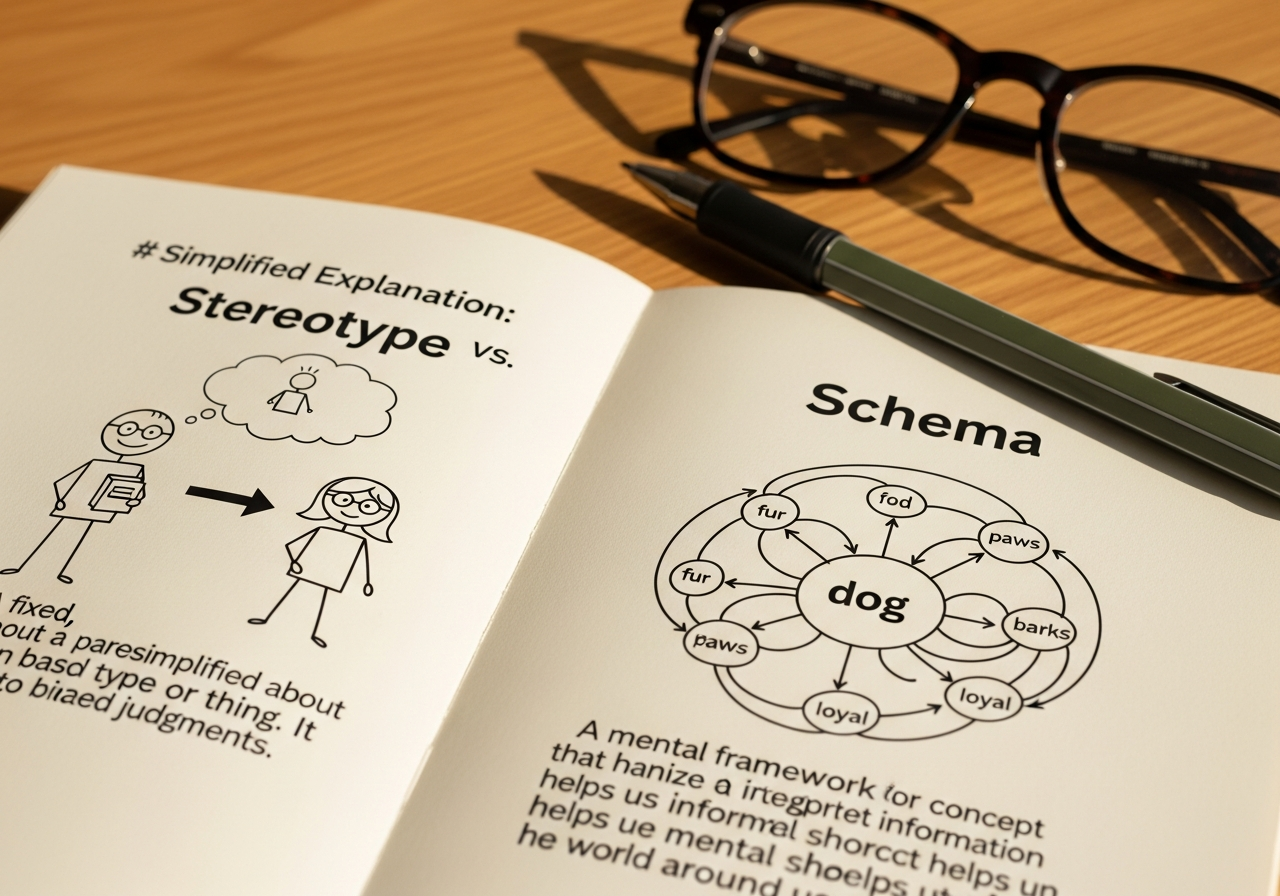
- Schemas: Mental frameworks that organize information.
- Heuristics: Mental shortcuts for making quick decisions.
- Cognitive biases: Systematic errors in our thinking.
- Social inference: How we draw conclusions about others.
- Causal attributions: How we explain the "why" behind people's behavior.
The main challenge is that many of these concepts are theoretical and subtle. It's not like learning the parts of the brain; here, you have to understand the logic behind each mental process, and that requires more than just reading and highlighting.
The Key Study Technique: Active Recall
If you could only choose one technique to study Social Cognition, this would be it. Forget rereading your notes twenty times until they're burned into your brain (spoiler: it doesn't work as well as you think). The key is active recall.
What does it involve? It's very simple: instead of putting information into your brain (reading), you make an effort to pull the information that's already inside out. It's the act of actively remembering what you've studied.
Neuroscience research suggests that this effort to remember strengthens the neural connections associated with that information, making the memory much stronger and more lasting. It's like doing push-ups for your brain.
How to Apply It to Social Cognition?
- Study a concept: Read and try to understand a topic, for example, the "availability heuristic."
- Close your notes: Put away the book, the PDF, everything.
- Try to explain it: Now, try to explain the concept in your own words. What is it? How does it work? Can you give a real-life example? (e.g., "If I see a lot of news about robberies, I'll think that robbery is much more common than it actually is, because those examples are more 'available' in my mind").
- Check and correct: Go back to your notes and check if your explanation is correct. Did you leave out anything important? Did you mix up any details? Correct your mistakes and fill in the gaps.
Repeating this process is infinitely more useful than passive rereading.
The Best Active Recall Tool: Multiple-Choice Exams
Asking yourself questions is great, but there's an even more powerful and structured way to apply active recall: practicing with multiple-choice exams.
Each question on a test forces you to do a small active recall exercise. You have to retrieve the correct definition from your memory and, more importantly, differentiate it from other very similar options (the famous distractors). This helps you solidify the nuances of each concept.
But let's be honest, who has time to create dozens of questions for every topic? It's a huge amount of work. This is where technology lends you a hand so you can focus on what really matters: practicing.
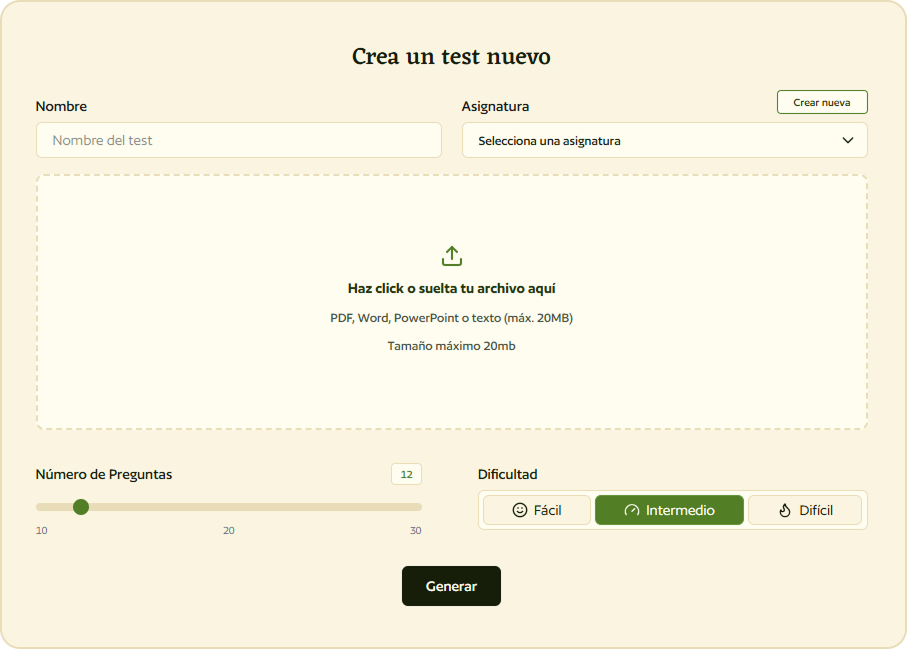
Smartests.app is a tool that turns your Social Cognition notes into multiple-choice exams in seconds. You just upload your document or paste the text, and our AI takes care of generating relevant questions for you to test your knowledge.
Create your own quizzes with Smartests
Social Cognition Multiple-Choice Exam (Practice Example)
Time to play! Here are 10 multiple-choice questions based on the 1st Year Psychology syllabus for Social Cognition. Try to answer them without looking at your notes. The answers are further down.
1. The "fundamental attribution error" refers to the tendency to: a) Overestimate situational causes in the behavior of others. b) Overestimate dispositional causes in the behavior of others. c) Attribute our successes to internal factors and our failures to external factors. d) None of the above.
2. When we judge the frequency or probability of an event based on how easily examples come to mind, we are using the: a) Representativeness heuristic. b) Anchoring and adjustment heuristic. c) Availability heuristic. d) False consensus effect.
3. A schema about the steps to follow in a restaurant (enter, sit down, order, eat, pay) is an example of a: a) Role schema. b) Person schema. c) Script. d) Self-schema.
4. The tendency to search for, interpret, and recall information that confirms our preexisting beliefs is known as: a) Hindsight bias. b) Confirmation bias. c) Illusory correlation. d) Self-fulfilling prophecy.
5. According to Kelley's covariation model, if a person always laughs at a particular comedian (high consistency), no one else laughs at him (low consensus), and this person doesn't laugh at other comedians (high distinctiveness), we attribute their laughter to: a) The person (internal attribution). b) The stimulus (the comedian). c) The situation (the circumstances). d) A combination of the person and the situation.
6. Which of the following processes is considered more "automatic" and less controlled in social cognition? a) Thought suppression. b) The activation of a stereotype. c) Correcting a first impression. d) Long-term goal planning.
7. The "self-fulfilling prophecy" or Pygmalion effect occurs when: a) Our expectations about another person cause that person to behave in a way that confirms those expectations. b) We remember past events as being more predictable than they actually were. c) We believe our opinions are more common than they really are. d) We judge others based on an initial trait that anchors our perception.
8. If you are asked to estimate whether the population of Turkey is more or less than 30 million, and then to give an exact figure, your final answer will likely be influenced by the initial figure of 30 million. This is an example of the: a) Availability heuristic. b) Anchoring and adjustment heuristic. c) Representativeness heuristic. d) Negativity bias.
9. "Self-schemas" are: a) The beliefs we have about the roles we occupy in society. b) Organized knowledge structures about ourselves, based on past experiences. c) The scripts we follow in familiar social situations. d) The expectations we have about the behavior of others.
10. The "correspondence bias" is a term often used as a synonym for: a) The self-serving bias. b) The fundamental attribution error. c) The false consensus effect. d) The confirmation bias.
Correct Answers
- b) The fundamental attribution error is our tendency to give more weight to someone's personality or disposition ("that's just how they are") than to the situation when explaining their behavior.
- c) The mental "availability" of examples influences our judgment.
- c) A script is a schema about a sequence of events in a known situation.
- b) Confirmation bias makes us "see" what we expect to see, ignoring contrary evidence.
- b) The combination of high consistency, low consensus, and high distinctiveness points to an external cause, in this case, the stimulus (the comedian is especially funny to that person).
- b) The activation of stereotypes usually occurs quickly and automatically, often outside of our awareness. The other processes require more deliberate mental effort.
- a) It's a cycle where one person's expectations influence another's behavior, who ends up fulfilling those expectations.
- b) We "anchor" to an initial piece of information (30 million) and "adjust" our estimate from there, but rarely enough.
- b) They are the core beliefs that define who we think we are.
- b) Both terms refer to the same tendency to overestimate dispositional causes when explaining others' behavior.

How Smartests.app Takes Your Studying to the Next Level
How did the quiz go? If you missed a few, great! Every mistake is an opportunity to spot a weak point in your studying and strengthen it.
Taking these quizzes is the most direct way to prepare, and with Smartests, the process is ridiculously easy.
- Upload your notes: Grab that PDF with your Social Cognition topics or just copy and paste the text.
- The AI analyzes them: Our system understands the key concepts, definitions, and the relationships between them.
- Generate your quiz: In seconds, you have a unique multiple-choice quiz, based 100% on the material you've studied.
This allows you to create unlimited, personalized practice. You can make a quiz for Topic 1, another for Topic 2, or one that mixes the first five. You have total control to study at your own pace and in your own way.
Quick Summary
If you take away one thing from this post, let it be this:
- Social Cognition: It's a dense subject that requires understanding, not just memorization.
- Key Technique: Forget passive rereading. Focus on Active Recall to force your brain to remember.
- Best Tool: Multiple-choice quizzes are the most efficient way to apply active recall and prepare for the real exam.
- The Easy Solution: Smartests.app automates the creation of quizzes from your own notes, saving you hours of work.
Pass Social Cognition Without the Drama
Switching from passive studying is the first step to improving your grades and reducing anxiety. Start actively testing your knowledge, and you'll see how the concepts of Social Cognition really start to click.
With Smartests, you can generate your first quiz in less than a minute. What are you waiting for?